
Last Updated: October 30, 2026
Quick Summary
A lot-matched peptide certificate ties a specific vial to a specific production batch by unique batch number, proving the material was tested, the results belong to that material, and your vial came from that tested material. Check the lot number character for character against the vial label, since a report with no lot number or a mismatched one breaks the match.
- Read a COA top to bottom as a chain of fields, treating each field as a gate.
- The test date should post-date the manufacture date on every report.
- HPLC purity measures how clean a sample is; mass spec confirms it is the right compound.
- Photograph the vial label before opening it and record the batch number in your lab notebook.
- Do not open the vial when you find a flag; request the lot-matched report for that exact batch.
Table of Contents
- What a Lot-Matched Peptide Certificate Actually Proves
- How to Read a Peptide COA: A Visual Walkthrough
- Finding Your Peptide COA by Lot Number
- Peptide Lot Traceability From Synthesis to Vial
- Peptide COA Red Flags That Should Stop a Purchase
- Lab Accreditation Standards Behind a Trustworthy Report
- Request the Lot-Matched Report Before Your Next Order
- Frequently Asked Questions
What a Lot-Matched Peptide Certificate Actually Proves
A lot-matched peptide certificate ties a specific vial to a specific batch. That sounds simple. It isn’t.
A common failure mode is a researcher receiving a clean-looking Certificate of Analysis (COA) that has nothing to do with the vial in hand.
A lot-matched peptide certificate is a lab report issued for one production batch, identified by a unique batch number, and connected to the exact vials filled from that batch. It proves three things:
- The material was tested
- The test results belong to that material
- The vial you received came from that tested material
Miss the third point and the first two mean nothing. A purity percentage on an unmatched report does not describe the product in hand.
Why a Generic COA Is Not Enough
Generic COAs are a recognized problem in this market. They can take several forms:
- A report with no batch number at all
- A report with a batch number that doesn’t match your vial label
- A report reused across many lots, sometimes for years
Each one breaks the chain between data and product. If you’re weighing whether COA paperwork is worth the effort, this article on whether research peptides with COA are worth the paperwork makes the case. Labs may discover this during an audit, when a reviewer asks: “Show me the analysis for this lot.”
How to Read a Peptide COA: A Visual Walkthrough
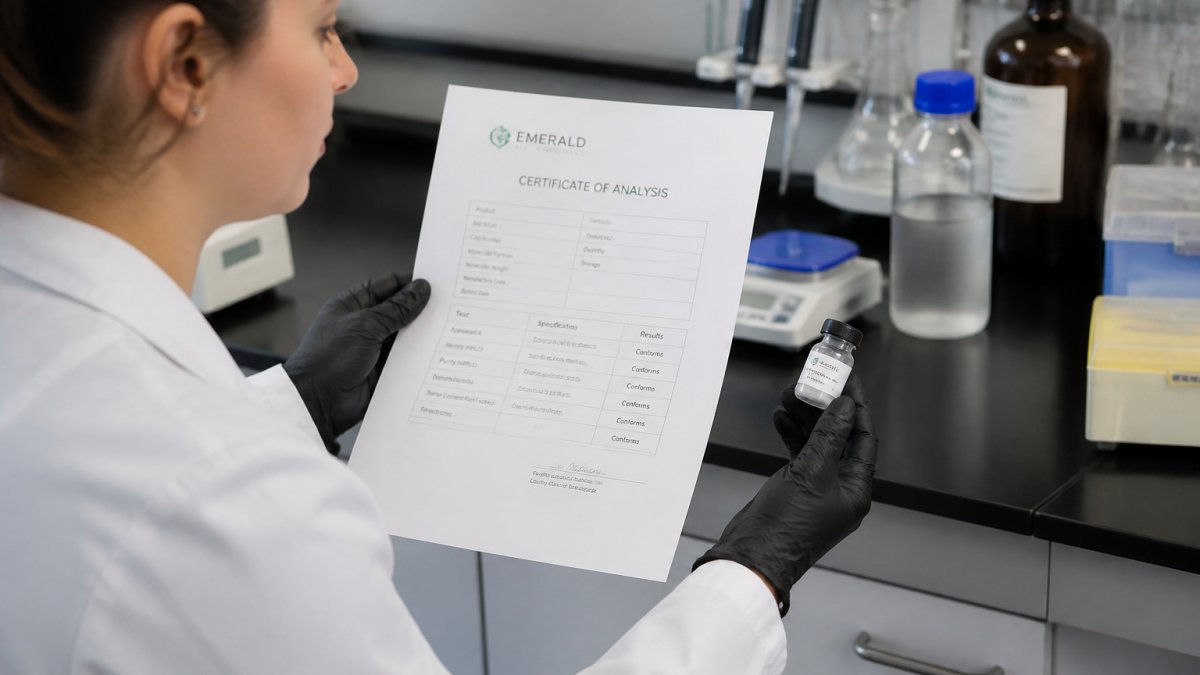
A COA should not be read by scanning straight to the purity number. Read it as a whole. A COA is a chain of fields, and the purity figure is only meaningful if every field above it checks out.
Print the COA and mark it up with a pen. A physical annotated copy filed with your sample record is faster to audit later than a PDF you have to re-read from scratch.
Field-by-field anatomy of a legitimate COA
**1.
2. Lot or batch number. This is the single most important field.
3. Manufacture and test dates. Two dates should appear: when the batch was produced and when the sample was analyzed.
**4.
5. Results table. Purity percentage, identity confirmation (observed mass versus theoretical mass), and any contaminant or residual-solvent screens.
**6.
7. Laboratory identity and accreditation. The testing lab’s full legal name, physical address, and accreditation reference should appear.
**8.
HPLC purity, mass spec, and identity confirmation
HPLC purity tells you what share of the sample eluted as a single peak. Mass spectrometry tells you the molecule’s mass matches the expected sequence. These answer different questions, and you need both.
A sample can show high HPLC purity and still be the wrong peptide. For a deeper look, our guide to peptide mass spectrometry reports walks through the full structure.
A COA that lists a method but no instrument, column, or detection wavelength is a summary, not raw data. Ask for the underlying chromatogram before you rely on the purity figure.
Quick field checklist
- Product name and sequence match the order
- Lot number matches the vial label character for character
- Test date post-dates the manufacture date
- HPLC method names column and detection wavelength
Read a COA top to bottom as a chain of fields, treating each one as a gate.
| Field | What to check | Warning sign |
|---|---|---|
| Header block | Product name, sequence, catalog number match order | Header says only “Peptide, 5mg” with no sequence |
| Lot or batch number | Unique alphanumeric string, same format as vial label | No lot number, or differs from vial by one character |
| Manufacture and test dates | Test date post-dates manufacture date | Test date precedes manufacture date |
| Methods block | Named methods, instrument type, column chemistry, detection wavelength | “HPLC: 99%” with no method detail |
| Results table | Specification limit next to each measured value | Bare numbers with no specification |
| Chromatogram and spectrum | Single dominant peak, peak at expected molecular mass | Purity number with no chromatogram |
| Laboratory identity and accreditation | Full legal name, physical address, accreditation reference | No lab named, or lab with no address |
| Signature and reviewer | Named analyst with signature or electronic sign-off | Unsigned COA |
Finding Your Peptide COA by Lot Number
Finding your peptide COA by lot number starts with the vial label, not the website. For a step-by-step walkthrough, see how to verify a peptide batch number. The batch number printed on the vial is the key.
A workable search process looks like this:
- Photograph the vial label before opening it
- Record the batch number in your lab notebook or LIMS entry
- Pull the COA for that exact number
- File the PDF alongside your sample record, not in a shared folder
No special software is required. A PDF filed with your research records satisfies most documentation requirements, and a naming convention like peptide-batch-COA-date.pdf keeps it findable.
Peptide Lot Traceability From Synthesis to Vial
Peptide lot traceability is the record of a batch’s path from synthesis through purification, testing, filling, and shipping. Each step should carry the same batch number forward.
Traceability breaks in predictable places:
- Purity testing happens on a small sample, but the report gets attached to the whole run without a link
- Vials are filled from a larger pool, and the fill record doesn’t reference the tested lot
- A supplier relabels material from an earlier batch without a new analysis
Any of these turns a valid report into a decoration. When you compare suppliers, ask one question: “Can you show me the fill record for my lot?” A supplier with real traceability answers without hesitation. If you’re tracking multiple lots, our guide to comparing peptide batches sets out the step-by-step method.
Peptide COA Red Flags That Should Stop a Purchase
Peptide COA red flags can often be spotted quickly. The harder skill is telling sloppy paperwork apart from a deliberately fabricated or templated document. The checklist below is organized by severity: document-level problems first, data-level problems second, fraud indicators third.
One flag alone might be sloppy paperwork. Two or more is a pattern. A fraud indicator plus any other flag is a stop.
Document-level problems
- No batch number anywhere on the report
- A batch number that does not match your vial
- The same COA PDF offered for multiple lots
- Missing test dates, or dates that predate the batch
Data-level problems
- Purity reported without a chromatogram
- Mass spec results with no spectrum or peak list
- Identity “confirmed” with no stated method
- Contaminant screens listed as “passed” with no limits given
COA fraud indicators: a checklist for templated or fabricated documents
These are the signs that separate a recycled or invented document from a merely incomplete one.
**1.
2. Missing lab contact block. A real testing laboratory publishes a physical address, phone number, and website.
**3. Our section on lab accreditation standards explains how to check.
4. Signature block inconsistencies. Look for a named analyst with a signature or electronic sign-off.
**5.
**6.
**7.
What to do when you find a flag
Do not open the vial. Photograph the label and COA together, record the lot number, and request the lot-matched report for that exact batch. If the supplier cannot produce a document with a matching lot number, a named lab, and a verifiable accreditation reference, treat the material as untested regardless of what the first COA said.
A clean-looking COA is not evidence of a clean lot. The match between the document and the vial is the evidence. If the match fails, the purity number is a number about someone else’s product.
Lab Accreditation Standards Behind a Trustworthy Report
Accreditation is a part of a COA that buyers may overlook, and it helps distinguish a testing lab from a print shop.
An accredited testing laboratory operates under a documented quality system, with defined methods, calibrated instruments, and traceable records. You can check a lab’s status through the official ISO/IEC 17025 standard overview and through the NIST quality standards resources that underpin measurement traceability.
What to check on the report itself:
- The testing lab’s full legal name and location
- An accreditation reference or certificate number
- The specific methods used, written out
- A named analyst or reviewer with a signature
If the COA names no lab, there’s nothing to verify. That’s the whole point of the document.
Once you know what a trustworthy report looks like, the next step is confirming the supplier behind it. Our guide to how to verify peptide supplier legitimacy covers that process.
Request the Lot-Matched Report Before Your Next Order
Here’s the practical version. Before you place an order, ask for the lot-matched report for the batch you’ll receive. Not a sample COA. Not a representative report.
A simple pre-order checklist:
- Supplier provides a unique batch number on every product
- COA is issued per lot, not per product line
- Report names the testing laboratory and method
- HPLC and mass spec results both appear
- Batch number on the COA matches the vial label
At Emerald Science, every lot is independently tested and mass-spec verified, with HPLC purity of at least 99%. Every product carries a unique batch number.
Orders placed before 2 PM EST ship the same day.
Frequently Asked Questions
What is a lot-matched peptide certificate?
A lot-matched peptide certificate is a Certificate of Analysis tied to one specific production batch, not a generic sample. The lot number printed on the vial label appears on the report, along with the HPLC purity result, mass spectrometry identity data, and testing date for that batch. This matters because two vials of the same peptide from different lots can differ in purity and acetate content. If the report does not carry your lot number, it tells you nothing about the material in your hands.
How do I verify a peptide COA by lot number?
Start with the batch number on the vial label and match it character for character against the report, including any suffix. Check that the report lists the peptide name, molecular weight, and test date, then confirm the HPLC purity figure and the mass spec result agree with what you ordered. Ask the supplier for the raw chromatogram and spectrum, not just a summary table. If you cannot pull the report yourself from the supplier’s verification database, request the PDF and file it with your research records.
Does a high HPLC purity result prove a peptide is authentic?
No. HPLC purity measures how much of the detected material elutes as a single peak, but it does not confirm the sequence is what you ordered. A peptide with the wrong sequence can still show 99% purity on an HPLC trace. Identity confirmation requires mass spectrometry, which reports the molecular weight and lets you compare it against the expected mass for your sequence. Both numbers belong on a lot-matched certificate, and you should treat a report with purity data but no mass spec as incomplete.
What should I do if a peptide lot number does not match its COA?
Do not use the material. Photograph the vial label and the report side by side, then contact the supplier in writing and ask for the correct lot-matched certificate. A mismatch can mean a labeling error, a mixed shipment, or a reused report, and none of those are safe to assume away. If the supplier cannot produce a matching report with raw analytical data, request a replacement or refund and document the exchange. Keep the batch quarantined until the paperwork resolves.
The gap between a COA and a lot-matched COA is the gap between paperwork and proof. Close it before your next order. Get started with Emerald Science and put a verified, batch-specific certificate behind every vial in your lab.