
Table of Contents
- Why a Peptide Batch Number Is Your First Quality Check
- Step 1: Locate the Batch Number on the Vial Label and Packaging
- Step 2: How to Read a Peptide Certificate of Analysis
- Step 3: Confirm the Issuing Laboratory and Report Identifiers
- Step 4: Independently Confirm the Report Is Authentic
- Step 5: Peptide Purity Standards HPLC and Mass-Spec Results Explained
- Step 6: Third-Party Peptide Testing Requirements to Look For
- Step 7: What to Do When Records Are Missing, Duplicated, or Inconsistent
- Frequently Asked Questions
Last Updated: October 21, 2026
Why a Peptide Batch Number Is Your First Quality Check
A peptide batch number is a unique identifier a supplier assigns to a specific production lot, and it connects the vial in your hand to a laboratory report.
At Emerald Science, we put a unique batch number on every product because untraceable lots cause problems: grant reviewers ask for documentation, assay results drift, and nobody can prove which vial came from which run.
Here is the uncomfortable truth most guides skip: a batch number proves nothing on its own. Your job is to test that claim against a certificate of analysis (CoA), the issuing laboratory, and an independent verification path.
Below is a seven-step workflow you can repeat for every order, about ten minutes per lot.
A batch number is only as good as the certificate it points to. Verification means matching three things: the vial label, the CoA header, and the laboratory that issued the report.
Step 1: Locate the Batch Number on the Vial Label and Packaging
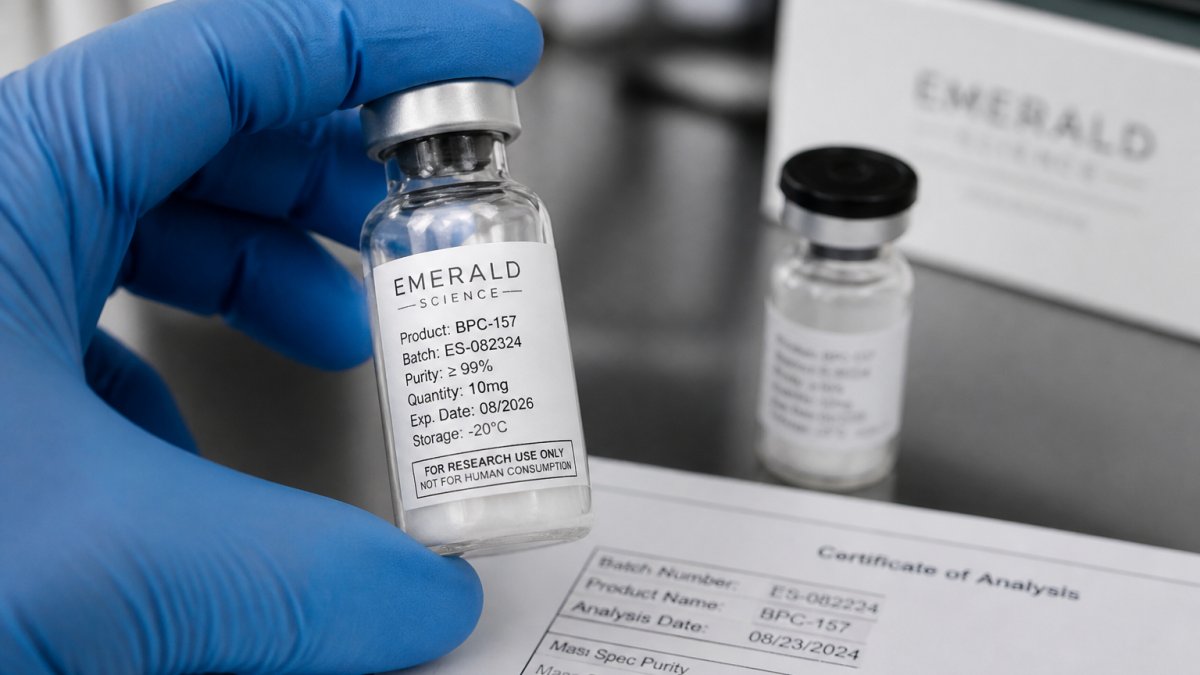
The batch number is usually printed on the vial label, near the compound name and fill date. Start there, then check the outer packaging and packing slip.
Look for labels like “Lot,” “Batch,” or a short alphanumeric string. Write it down exactly, including hyphens and leading zeros, a single transposed character sends you to the wrong record.
Where the Number Usually Sits on a Vial
Most vials carry a small label with limited space. Expect:
- Compound name and quantity
- Lot or batch number, often a letter-number mix
- A manufacturing or fill date
If the label is smudged or the number unreadable, contact the supplier before opening the vial. A supplier that cannot confirm a lot number has a documentation problem.
Step 2: How to Read a Peptide Certificate of Analysis
A certificate of analysis reports the test methods and results for one specific lot, not a marketing sheet. It should name the compound, the lot, the methods, and the results.
When you learn how to read a peptide certificate of analysis, you stop skimming and start checking. Read the header first, then the methods, then the results. Most people read it backward and get fooled.
Matching the Vial Label to the CoA Header
The CoA header should list the same lot number printed on your vial, plus the compound name and analysis date. Compare character by character.
Watch for these mismatches:
- Different lot number: the report belongs to another run.
- Different compound spelling or sequence: wrong product.
- Missing lot field: the report is generic, not batch-specific.
A CoA that lists only a compound name and no lot number is a catalog sheet, not a batch record. It cannot confirm your vial.
Step 3: Confirm the Issuing Laboratory and Report Identifiers
The issuing laboratory should be named, with an address and contact details. A report with no laboratory name is not verifiable. Check for a report number, issue date, and revision number, then confirm the laboratory has a published website, phone number, and list of analytical methods.
A CoA with no laboratory name, no address, and no report number is untraceable. Anyone can design a document that looks official. Without an issuer you can contact, the report is decoration.
Step 4: Independently Confirm the Report Is Authentic
Independent confirmation means validating the report through a channel the supplier does not control. A PDF on a seller’s site, a QR code, or a link embedded in the CoA are supplier-controlled artifacts, possibly accurate, but not proof. The test is whether the issuing laboratory, reached through its own published contact details, will stand behind the report number and the lot it describes.
Build the verification path yourself
- Write down the laboratory’s legal name exactly as printed on the CoA. Not a trade name or parent company, the legal entity is what a lookup or phone call is keyed to.
- Find the laboratory’s own website independently. Type the domain into a browser rather than clicking a link in the CoA. If the CoA lists
labname-analytics.combut the real laboratory publishes atlabname.com, resolve that mismatch first. - Locate a report lookup or verification page on that domain. Many contract labs publish a report-number search. If one exists, search the report number and confirm the compound and lot match your vial.
- If no lookup exists, use the contact details published on the laboratory’s own site, not the phone number or email printed on the CoA. Ask two questions: did you issue report number [X], and does it cover lot [Y] for compound [Z]? A laboratory that issued the report can answer both.
- Ask for the report directly from the laboratory if the supplier’s copy looks altered. Most labs will confirm its contents, the strongest independent confirmation available to a researcher who did not commission the test.
What a laboratory can and cannot confirm
A laboratory can confirm that it issued a report with a given number, on a given date, for a given sample description, and that the results in your copy match its records.
A laboratory generally cannot confirm that the vial in your hand is the sample that was tested. Chain of custody runs from the submitting party to the laboratory, not from the laboratory to your bench.
A verification link or QR code printed on a CoA can point to a supplier-controlled page that mimics a laboratory’s branding. Always navigate to the laboratory’s domain yourself and search from there. If the only way to ‘verify’ a report is to click a link the supplier provided, you have not verified anything.
Signals that independent confirmation succeeded
- The laboratory’s own site lists the report number, or a representative confirms it by phone or email from a published address.
- The compound, lot, and sample description on the laboratory’s record match the CoA you were given.
- The issue date matches the CoA, and any revision history is consistent.
Signals that it did not
- The laboratory has no record of the report number.
- The laboratory’s published contact details differ from those on the CoA.
- The laboratory confirms the report number but not the lot or compound.
Record the outcome in your log: laboratory name, report number, channel used, date, and anyone you spoke with. That record turns a CoA from a document into evidence.
Step 5: Peptide Purity Standards HPLC and Mass-Spec Results Explained
HPLC and LC-MS answer two different questions, and conflating them is the most common mistake researchers make when reading a CoA. HPLC separates a sample’s components and reports how much of the detected signal comes from the target peak versus everything else. LC-MS measures the mass of the molecules and compares it to the mass expected for the stated sequence.
What an HPLC purity figure actually represents
A purity figure on a peptide CoA is almost always a peak-area percentage, the target peak area divided by the total area of all integrated peaks, times 100. That number is method-dependent: change the column, gradient, detection wavelength, or integration parameters, and the same sample can report different figures. This is why the method must be stated on the report.
When you read the HPLC section, check for:
- Method details: column type, mobile phase, gradient, flow rate, detection wavelength (commonly 214 nm or 220 nm for peptides).
- The chromatogram itself, not just the number. A clean single peak with a flat baseline tells you more than a percentage alone. A broad or split peak, a rising baseline, or a cluster of small peaks near the main peak are worth noting even if the reported purity is high.
- Integration parameters if published. Aggressive baseline subtraction or peak smoothing can inflate a purity figure.
Peak-area purity is relative, not absolute. It reflects what one detector saw under one method on one day. Treat it as a strong signal about the sample, not a guarantee about the product, and always check that the method is stated on the report.
What LC-MS confirms, and what it does not
The LC-MS section should report an observed mass (or m/z) and compare it to the theoretical mass calculated from the stated amino acid sequence. A close match supports identity: the dominant molecule has the mass the label claims.
What LC-MS does not do:
- It does not prove the sequence order. Two peptides with the same amino acid composition but a different order can share a mass. Sequence confirmation typically requires tandem MS (MS/MS) or sequencing-grade analysis, which most routine CoAs do not include.
- It does not establish purity. A sample can be the right molecule and still contain significant impurities.
- It does not detect everything. Small truncations, deamidated variants, or counterions may not resolve clearly depending on the method.
Why one test is not a quality verdict
A CoA with a high HPLC purity figure and a matching mass is a meaningful signal, but not a complete quality assessment. It does not tell you about:
- Sterility or endotoxin content, which require separate microbiological testing.
- Residual solvents or counterion content, which require separate chemistry testing.
- Water content or salt form, which affect how the mass and purity figures should be interpreted.
This is why the strongest CoAs state the methods, publish the chromatogram and mass spectrum, and are batch-specific.
Reading the two sections together
The practical workflow: confirm the HPLC method and inspect the chromatogram for peak shape and baseline; confirm the LC-MS observed mass against the theoretical mass; then ask what the report does not cover. If sterility, endotoxin, or residual solvents matter for your work, check whether those tests appear on the CoA or a separate report for the same lot. If not, the CoA has answered purity and identity and left the rest open, normal, but worth knowing before you rely on the document.
Step 6: Third-Party Peptide Testing Requirements to Look For
Third-party peptide testing requirements come down to independence: the laboratory that runs the test should not be the party selling the product. Ask any supplier:
- Is the testing done by an outside laboratory?
- Is the laboratory named on every CoA?
- Are results batch-specific, not pooled across lots?
A supplier that publishes batch-specific, laboratory-hosted reports is doing the work. One that sends a generic sheet on request is not.
Step 7: What to Do When Records Are Missing, Duplicated, or Inconsistent
Missing, duplicated, or inconsistent identifiers are common, and each has a fix.
| Problem | What It Looks Like | What to Do |
|---|---|---|
| Missing record | No CoA for the lot | Request it in writing; do not use the lot until it arrives |
| Duplicate lot number | Same number on two different products | Ask the supplier to confirm which record applies |
| Inconsistent identifiers | Vial lot differs from CoA lot | Treat as unverified; request a corrected report |
| Withdrawn batch | Supplier flags a recall or revision | Stop use and follow the supplier’s guidance |
| Generic CoA | No lot number at all | Ask for a batch-specific report |
Keep a simple log: compound, lot number, laboratory, report number, date received. PDFs filed with your research records satisfy most documentation requests.
Emerald Science ships unique batch numbers on every product and independently tests each lot, with mass-spec verification and HPLC purity of at least 99% on every batch.
Frequently Asked Questions
What is a peptide batch number, and why does it matter?
A peptide batch number, also called a lot number, is the identifier a supplier assigns to a specific production run. It ties your vial to one set of analytical results, so you can pull the exact certificate of analysis for the material in your hands. Without it, a CoA tells you nothing about your specific vial, only about some vial the supplier tested at some point. Record the peptide batch number in your lab notebook and file the matching CoA with your research records.
How do I know if a peptide certificate of analysis is authentic?
Check three things. First, the report identifier and batch number on the CoA should match your vial label exactly. Second, the issuing laboratory should be named with a verifiable address and contact details, and the report should be hosted on that laboratory’s own site, not only on the supplier’s. Third, look for a revision history and issue date that make sense. If the CoA is a generic PDF with no lab name, no report number, and no way to confirm it with the testing lab, treat it as unverified.
What do HPLC purity standards actually show on a peptide CoA?
An HPLC trace shows how much of the sample elutes as the target compound versus impurities, and the reported purity percentage is the area under the main peak relative to total peak area. A figure of 99% or higher means the main peak dominates, but it does not by itself confirm identity. That is why a CoA should pair HPLC purity data with mass spectrometry, which confirms the molecular weight matches the expected sequence. Read both results together before accepting a purity claim.
What should I do if my vial’s batch number has no matching CoA?
Do not assume the material is fine because the supplier is otherwise reputable. Ask the supplier in writing for the batch-specific report and a link to the laboratory-hosted version. If they send a CoA for a different lot, or only a generic report, treat the batch as undocumented. Hold the material out of grant-funded or client work until it is resolved, and note the gap in your records. A missing record is a documentation failure you can escalate; a substituted one is a red flag worth acting on.
Verifying a peptide batch number is a habit, not a one-time task. The labs that get burned are the ones that trust a label and skip the paperwork. Build the ten-minute check into your intake process, and you will catch mismatches before they reach an assay. Emerald Science supports that habit with unique batch numbers on every product, independently tested lots, mass-spec verified identity, and same-day shipping on orders placed before 2 PM EST. Verify your next lot and continue with confidence.