
Table of Contents
- Why Verifying Peptide Supplier Legitimacy Matters for Research
- How to Read a Peptide Certificate of Analysis
- Understanding Third-Party Peptide Testing Standards
- Recognizing Peptide Supplier Red Flags
- Questions to Ask a Peptide Supplier Before Ordering
- Verifying Business Identity and Transparency
- Building a Verification Workflow for Peptide Orders
- Frequently Asked Questions
Last Updated: October 16, 2026
Why Verifying Peptide Supplier Legitimacy Matters for Research
Ordering peptides from an unreliable source can waste months of work and grant funding. Bad batches introduce inconsistencies that invalidate results. Contaminated or mislabeled samples force you to repeat experiments.
The stakes are high for research institutions. A contaminated peptide batch can compromise an entire study. Your lab’s reputation depends on data integrity. Funding agencies expect rigorous sourcing practices. That’s why verification isn’t a nice-to-have step, it’s essential.
When you verify peptide supplier legitimacy, you’re checking three core things: whether the supplier’s documentation is authentic, whether their testing is independent and credible, and whether the business itself is legitimate and transparent. Each check catches different problems.
Verifying your peptide supplier protects your research integrity, saves time, and prevents costly batch failures. Start verification before you place your first order.
How to Read a Peptide Certificate of Analysis
A Certificate of Analysis (COA) is your primary defense against low-quality peptides. It documents what testing was done and what the results show. But not all COAs are equal. Some are detailed and specific. Others are vague marketing documents.
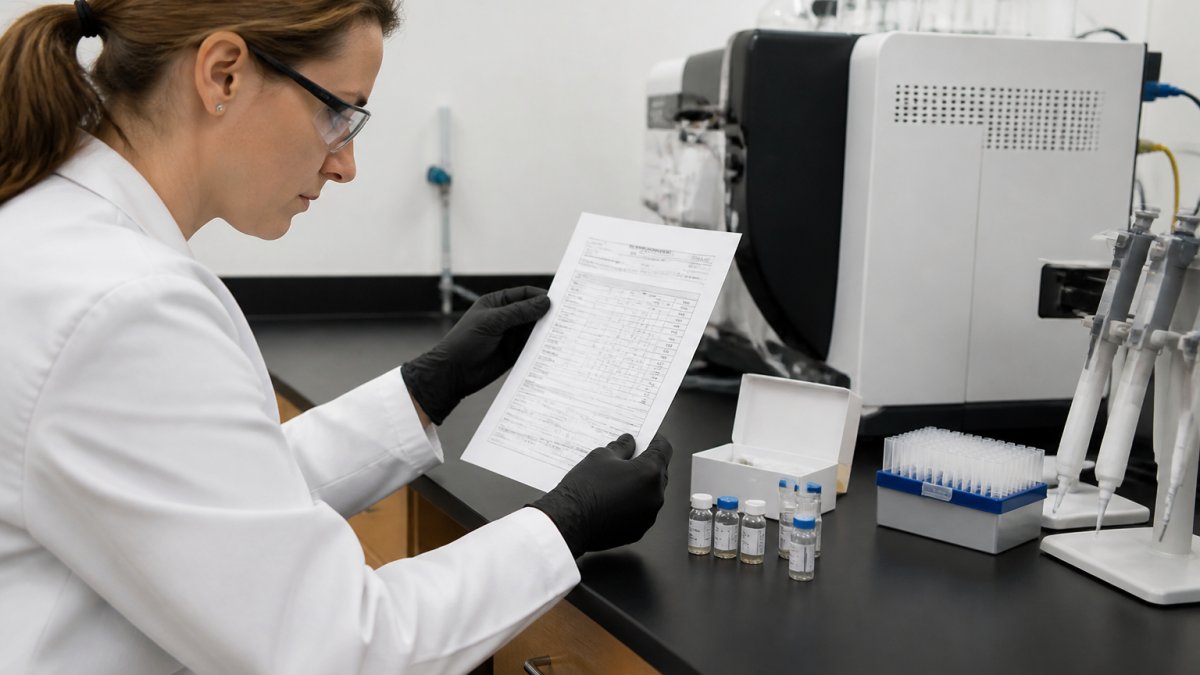
What a Valid COA Must Contain
A legitimate COA includes specific batch information tied to your order. It should list the exact lot number, the date of analysis, and the specific tests performed. Generic COAs that apply to all batches are a red flag.
Look for these required elements:
- Batch-specific lot number, matches your invoice
- Date of analysis, recent, not months old
- Test methods used, HPLC, mass spectrometry, or both
- Purity percentage, specific number, not a range
- Identity confirmation, the peptide matches what you ordered
- Lab name and contact information, traceable to a real facility
If a COA lacks any of these, ask for a complete one before paying. A supplier who refuses to provide batch-specific documentation is hiding something.
Generic COAs that claim to represent “all batches” or “typical results” are not valid. Every batch needs its own documentation. This is a major red flag for supplier legitimacy.
Verifying Batch-Specific Documentation
Batch-specific testing means the supplier tested YOUR exact batch, not a representative sample. This matters because peptide synthesis isn’t perfectly consistent. Small variations happen between batches.
When you receive a COA, verify these details match your order:
- Lot number, compare it to your purchase receipt
- Synthesis date, should be recent, ideally within the last month
- Analysis date, should be after synthesis, typically within one week
- Quantity tested, should match or exceed your order size
If the lot number on the COA doesn’t match your invoice, contact the supplier immediately. This disconnect means either the wrong batch was shipped or the documentation is reused, both are serious problems.
Understanding Third-Party Peptide Testing Standards
Independent laboratory testing is the most reliable verification method. When a neutral third party tests your peptide, you get unbiased results. The supplier can’t manipulate the outcome.
Third-party testing typically involves sending a sample to an accredited lab that has no financial stake in the result. The lab tests the sample against the peptide’s specification and issues a report. This report becomes part of the COA.
Not all suppliers use third-party testing. Some test in-house only. In-house testing is faster and cheaper, but it lacks independence. A supplier has incentive to report favorable results. Third-party labs have no such incentive.
HPLC and Mass Spectrometry Results Explained
High-Performance Liquid Chromatography (HPLC) measures purity (pubmed.ncbi.nlm.nih.gov). It separates the peptide from impurities and quantifies how much pure peptide is present.
HPLC results appear as a chromatogram, a graph showing peaks. The largest peak is your peptide. Smaller peaks are impurities.
Mass spectrometry confirms identity. It measures the molecular weight of your peptide.
A complete COA includes both tests. HPLC alone shows purity but not identity. Mass spectrometry alone confirms identity but not purity. Together, they provide full verification.
Look for these specifics in test results:
- HPLC purity percentage (should match the specification)
- Retention time (confirms the peak is your peptide)
- Molecular weight from mass spectrometry
- Calibration information for the instruments used
If a COA shows only one test, ask why the other wasn’t performed. Legitimate suppliers run both.
Laboratory Accreditation and ISO 17025 Verification
Accreditation matters. It means an independent body has audited the lab’s processes and confirmed they meet standards.
ISO 17025 labs follow strict protocols for sample handling, equipment maintenance, and result reporting. They undergo regular audits. This structure reduces the chance of errors or fraud.
When you review a COA, check whether the testing lab holds ISO 17025 accreditation. The COA should state this. If it doesn’t, ask the supplier directly.
Not all peptide labs are ISO 17025 accredited. Some are smaller operations. Accreditation costs money and requires documentation. But for grant-funded research, accreditation provides legal and scientific protection.
Recognizing Peptide Supplier Red Flags
Certain warning signs indicate a supplier lacks legitimacy. Learning these flags saves you from wasted orders and failed experiments.
Red flags to watch for:
- No COA available, supplier claims “upon request” but doesn’t provide details
- Generic COAs, same document for all batches, no lot numbers
- No third-party testing mentioned, only in-house results
- Vague purity claims, “high purity” instead of a specific percentage
- No batch numbers on products, each vial should have a unique identifier
- Outdated test dates, COA is months old
- Lab contact information missing, can’t verify the testing facility
- Pressure to order quickly, legitimate suppliers don’t rush you
- No website or limited online presence, hard to verify business details
- Unresponsive to technical questions, won’t answer questions about testing methods
If a supplier exhibits multiple red flags, move on. The risk isn’t worth the cost savings.
Suppliers who refuse to provide batch-specific COAs or who claim all their batches are identical are likely cutting corners on quality control. This is a serious red flag for peptide supplier legitimacy.
Questions to Ask a Peptide Supplier Before Ordering
Direct questions reveal how transparent a supplier is. Evasive answers suggest problems.
Ask these questions before placing your order:
-
Do you provide batch-specific COAs for every order?, Should be yes, without hesitation.
-
Who performs your testing, your lab or a third party?, Third-party is better for independence.
-
Is your testing lab ISO 17025 accredited?, Ask for proof if they say yes.
-
Can I see a sample COA before ordering?, Legitimate suppliers provide examples.
-
How quickly can you provide the COA after I order?, Should be within 1-2 weeks.
-
Do you test for both purity and identity?, Both are necessary for verification.
-
What happens if a batch fails testing?, Do they resynthessize or refund?
-
How do you handle batch consistency across multiple orders?, Should describe quality controls.
-
Can I contact your testing lab directly to verify results?, If they say no, that’s suspicious.
-
What’s your refund policy if I’m not satisfied?, Confidence shows in their guarantee.
Suppliers who answer clearly and provide documentation are more trustworthy than those who deflect or minimize these questions.
Verifying Business Identity and Transparency
A legitimate business is traceable. You should be able to find real information about the company, its ownership, and its location.
Business Registration and WHOIS Lookup Checks
Start with basic business verification. Every legitimate business is registered with the state where it operates.
Steps to verify business identity:
-
Search the state business registry, Most states maintain online databases of registered businesses. Search for the company name and confirm it exists.
-
Check the WHOIS record, For the company website, look up the domain’s WHOIS information. This shows who registered the domain and when. Legitimate businesses register domains in their own name or through a company registrar. Domains registered anonymously or under different names are suspicious.
-
Look for physical address, The website should list a real street address, not just a P.O. box. You can verify the address using Google Maps or a business directory.
-
Verify phone number, Call the listed number. It should connect to a real person or business line, not a generic voicemail.
-
Check business license, Many states require businesses to display their license number. Verify it matches the state registry.
Legitimate suppliers maintain transparent business information. They’re not hiding their identity.
Assessing Supplier Contact Information and Responsiveness
How a supplier communicates tells you a lot. Responsive, professional communication suggests a stable business. Slow or evasive responses suggest problems.
Test responsiveness before ordering:
- Email a technical question, Does someone respond within 24 hours?
- Call the phone number, Does it ring to a real person or a voicemail that’s never checked?
- Ask about batch availability, Can they give you a timeline?
- Request a sample COA, Do they provide one quickly?
A supplier who ignores your questions before the sale will be worse after.
Building a Verification Workflow for Peptide Orders
Create a repeatable checklist so you verify every supplier consistently. This workflow takes 20-30 minutes and prevents costly mistakes.
Pre-order verification workflow:
-
Research the supplier, Search for company information, reviews, and business registration. Spend 5 minutes on this.
-
Request a sample COA, Email the supplier and ask for an example COA. Wait for their response.
-
Evaluate the COA, Check it against the requirements above. Does it include lot numbers, test dates, and specific purity percentages?
-
Verify the testing lab, Contact the lab directly or look up their ISO 17025 accreditation. Confirm they actually performed the tests.
-
Ask clarifying questions, Use the question list above. Note how quickly they respond.
-
Check business details, Verify business registration, WHOIS, and physical address.
-
Make a decision, If everything checks out, place a small initial order. If anything seems off, find another supplier.
Post-order verification:
-
Compare COA to order, When you receive the peptide, verify the lot number on the COA matches your invoice.
-
Inspect the vial, Check that the batch number on the physical vial matches the COA and invoice.
-
Document everything, Keep the COA, invoice, and any correspondence in your lab records.
-
Run your own tests if possible, If your lab has HPLC capability, run a quick purity check to confirm the supplier’s results.
This workflow becomes routine after a few orders. It protects your research and builds confidence in your supplier relationship.
Verifying how to verify peptide supplier legitimacy protects your research, saves time, and prevents batch failures that compromise your work. The process is straightforward: check the COA, verify the testing lab, confirm business identity, and ask direct questions. Emerald Science provides batch-specific COAs with mass-spec verified identity and independently tested HPLC purity of at least 99% on every lot.
Frequently Asked Questions
What should a peptide certificate of analysis include?
A valid COA must list the peptide name, batch or lot number, molecular weight, purity percentage (typically ≥99% HPLC), and the date of analysis. It should identify the testing laboratory, include HPLC and mass spectrometry results, specify the analytical methods used, and provide contact information for the supplier. Batch-specific documentation ensures you can trace the exact product you received and verify that it meets your grant or research protocol requirements.
How can you tell if a peptide supplier is legitimate?
Legitimate suppliers provide batch-specific COAs with third-party laboratory testing results, maintain transparent business registration and contact information, respond promptly to technical questions, and offer reproducible batch consistency. Verify the testing laboratory’s ISO 17025 accreditation, check the supplier’s business registration through official databases, and request references from other research institutions. Avoid suppliers who refuse to provide mass-spec verification, lack verifiable contact details, or make vague claims about purity without supporting data.
What are common red flags when buying research peptides online?
Red flags include suppliers offering unusually low prices without justification, refusing to provide batch-specific COAs or test results, lacking verifiable business registration or physical contact information, failing to respond to technical inquiries, claiming 100% purity (unrealistic), or providing generic certificates not tied to specific lot numbers. Be cautious of suppliers with no domain history, no laboratory accreditation verification, or testimonials that appear fabricated. Legitimate suppliers transparently document their quality control processes and testing standards.
What questions should you ask a peptide supplier before ordering?
Ask whether COAs are provided for every batch with mass-spec verification, which third-party laboratory performs testing and whether it holds ISO 17025 accreditation, what the typical turnaround time is for batch-specific documentation, how the supplier handles quality failures or batch inconsistencies, whether custom sequences or non-standard specifications are supported, and what storage and shipping protocols are used to maintain peptide integrity. Request references from other research institutions and ask about their replacement or refund policy for batches that fail to meet stated specifications.