
Last Updated: November 10, 2026
Quick Summary
A peptide lot number is the code on a vial label that ties that specific vial to one production run and its testing records. The peptide lot number meaning comes down to traceability: it links the physical vial to a batch identifier, a synthesis event, and a batch-specific Certificate of Analysis (COA). It is a batch identifier, not a purity grade.
- A lot number identifies a group of vials from one production run; a serial number identifies a single unit.
- The COA number identifies the report document itself and should reference the lot number, but is not the same number.
- Photograph the entire label and write the lot number down exactly, including hyphens and letter case.
- Compare the lot number character-for-character, because the last digits often separate one run from another.
- A missing, illegible, or mismatched lot number is a stop sign: contact the supplier before use.
Table of Contents
- What a Peptide Lot Number Means on a Vial
- How to Read a Peptide Label Without Guessing
- Step-by-Step Peptide Lot Number Verification
- Running a Peptide COA Lookup and Reading What Comes Back
- Why Two Batches of the Same Peptide Test Differently
- What a Lot Number and COA Cannot Prove
- When the Lot Number Is Missing, Illegible, or Mismatched
- Verify Your Lot Before You Run the Assay
- Frequently Asked Questions
What a Peptide Lot Number Means on a Vial
A peptide lot number is the code printed on a vial label that ties that specific vial to one production run and its testing records.
Emerald Science products carry a unique batch number for exactly this reason.
Here is the core idea in one sentence: a lot number is a batch identifier, not a purity grade. It tells you which run made the vial.
So why does this matter so much? Because without a lot number, a COA is just a piece of paper.
Lot Number, Batch Number, Serial Number, COA Number: Four Different Things
These four terms get mixed up constantly, and the confusion causes real problems in the lab.
- Lot number / batch number: Often used interchangeably. Both identify a group of vials made in the same production run. This is the number you match to a COA.
- Serial number: Identifies one single unit, not a group. You rarely see these on research peptides.
- COA number: The identifier on the Certificate of Analysis document itself. It should reference the lot number, but it is not the same number.
A common mistake is treating the COA number as the lot number. They serve different jobs. The lot number points to the batch.
The four identifiers on a peptide label each do a different job, and mixing them up is a common source of lab error.
| Identifier | What it identifies | Note |
|---|---|---|
| Lot number / batch number | A group of vials from one production run | The number you match to a COA |
| Serial number | One single unit, not a group | Rarely seen on research peptides |
| COA number | The Certificate of Analysis document itself | Should reference the lot number, but is not the same number |
| Expiration date | The date the product expires | Not a batch identifier |
How to Read a Peptide Label Without Guessing
Reading a peptide label is straightforward once you know what to look for and where to look. Most confusion comes from labels that pack a lot of small text into a tight space, not from missing information.
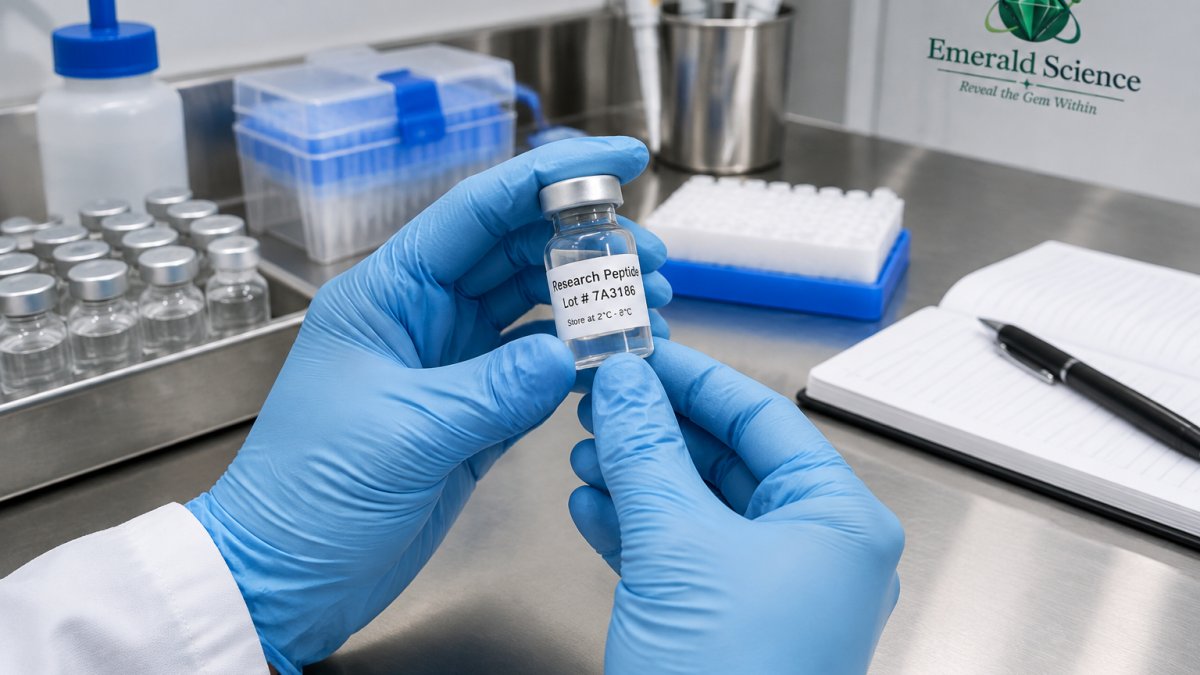
Check for these items every time:
- Product name and sequence, so you confirm the compound.
- Lot or batch number, the key identifier.
- Quantity and form, such as milligrams and whether it is lyophilized powder.
- Storage instructions, usually a temperature range.
- Manufacturer name and contact, so you know who to ask for the COA.
If a label is missing the lot number, stop. Do not assume. A vial without a batch identifier cannot be matched to testing documentation.
Common Lot Number Formats and Where They Sit on the Label
Lot numbers come in many formats. You might see a simple alphanumeric code, a date-based string, or a prefix that encodes the product line. Some illustrative patterns:
LOT-2405-A17, a prefix, a date code (year and month), and a run suffix.ES2026-0412, a manufacturer prefix, year, and sequential run number.B24-118-03, a product-line letter, year, batch sequence, and sub-batch.
These are illustrative formats, not a standard.
Where does it sit? On most research vials, the lot number appears in one of four places:
- Below the product name, often on the same line as the quantity.
- In the lower corner of the label, sometimes rotated 90 degrees on small vials.
- Along the crimp or cap edge, printed on the flip-off seal rather than the body label.
On small vials, the lot number may be printed vertically. Turn the vial under good light and read every line before you set it down.
A practical habit: photograph the entire label, not just the lot number.
Watch out: some labels use a date code that looks like a lot number (for example, EXP 2026-04).
Step-by-Step Peptide Lot Number Verification
Verification is a short process, and it protects your whole experiment. Here is how the process typically works.
- Photograph the vial label before opening anything. Get the lot number sharp and legible.
- Write the lot number down exactly, including hyphens and letter case.
- Request or locate the COA for that product and that lot.
- Compare character-for-character.
A17is notA71. - Confirm the product name and sequence on the COA match your vial.
- Check the test date to confirm the report belongs to a current run.
- File the label photo and COA together in your records.
A common mistake is matching only the first few characters. The last digits are often what separate one run from another. Read the whole string.
For a fuller walkthrough of each stage, see our guide on how to verify a peptide batch number.
Running a Peptide COA Lookup and Reading What Comes Back
A peptide COA lookup means finding the Certificate of Analysis that matches your specific lot, then reading it against the vial in your hand. The lookup is the easy part. Reading it carefully is where most people rush.
When you pull up a COA, confirm the lot number matches first. Everything else depends on that match. If the numbers line up, move to the content.
If you are new to these documents, our page on how to read a peptide COA walks through each section line by line. And if you want to be sure the report is genuinely tied to your vial, our guide to lot matched peptide certificate checks covers the match test in detail.
What a Certificate of Analysis Should Contain
A COA should be specific to the batch, not a generic spec sheet. Look for these elements:
- Lot number that matches your vial
- Product name and sequence
- Test method used, such as HPLC for purity and mass spectrometry for identity
The key distinction: a batch-specific COA references your lot. A generic COA does not. If the report could apply to any vial the company ever made, it tells you very little about yours.
Why Two Batches of the Same Peptide Test Differently
Two batches of the same peptide can test differently because each one is a separate production run. Peptide synthesis involves many steps, and small variations between runs can shift the final purity or the trace impurities present.
This is normal. It is also why batch variation is exactly what lot numbers exist to track. A report from one run does not automatically describe the next.
What most guides miss is that a difference between batches is not automatically a red flag. If you are comparing two vials, our step-by-step guide on how to compare peptide batches shows how to line up the reports side by side.
What a Lot Number and COA Cannot Prove
A lot number and a COA have real limits, and knowing them makes you a sharper buyer. The lot number proves linkage, it ties a physical vial to a batch record. The COA describes that batch at the time of testing.
Here is what they cannot do, and why:
- They cannot prove the vial is what the label says if the documentation was never independently verified. A COA is only as trustworthy as the laboratory that issued it. If the report was generated in-house or by an unidentified lab, the lot number still matches, but the testing behind it may not be independent. Verifying the lab’s identity and contacting it directly is the only way to close that gap.
- They cannot guarantee stability after shipping or storage. A COA reflects the batch at the time of analysis, not after temperature excursions in transit or months in a fridge. Lyophilized peptides are generally more stable than reconstituted ones, but a COA cannot tell you whether a vial was left on a loading dock in July.
- They cannot confirm your handling once the vial leaves the manufacturer. Reconstitution with the wrong solvent, repeated freeze-thaw cycles, or exposure to light can degrade a peptide that tested at high purity. The COA describes the starting point, not your bench practices.
The COA describes the batch at the time of testing. It is a record, not a live guarantee. Treat it as strong evidence, not absolute proof.
When the Lot Number Is Missing, Illegible, or Mismatched
A missing, smudged, or mismatched lot number is a stop sign. Do not guess and do not proceed as if the vial matches a report you found.
Here is what to do:
- Missing: contact the supplier and request the batch documentation before use.
- Illegible: photograph what you can and ask the supplier to confirm the lot from your order records.
- Mismatched: do not assume a typo. A mismatch means the COA may belong to a different run.
If you are stuck on any of these, you can contact our team with your order details and we will help you sort out the batch records.
Watch out: using a vial whose lot number does not match its COA defeats the entire point of traceability.
Verify Your Lot Before You Run the Assay
The habit that separates careful labs from careless ones is simple: verify the lot before you run the assay, every single time.
Emerald Science products carry a unique batch number, and every lot is independently tested and mass-spec verified to at least 99% HPLC purity.
Ready to run with a supplier that makes verification easy?
Verification is not a formality. It is the step that keeps your results reproducible.
Frequently Asked Questions
How do I match a peptide lot number to a certificate of analysis?
Find the lot or batch identifier printed on the vial label, then request the COA for that exact identifier from the supplier. Compare the two character for character, including hyphens and letter prefixes, because a single transposed digit points to a different production run. The COA should list the same lot number, the test methods used, identity and purity results, and the test date. If the COA has no lot number at all, treat it as a generic document rather than proof for your specific vial.
Does a lot number prove a peptide’s purity?
No. A lot number only identifies which production run a vial came from. The purity claim comes from the analytical testing recorded on that lot’s COA, usually an HPLC purity percentage and a mass-spec identity confirmation. Even then, the COA reflects the sample the lab tested, not every vial in the run. For grant-funded work, many labs run their own in-house check on arrival rather than relying solely on the supplier’s documentation.
What should I do if the lot number on the label does not match the COA?
Stop and do not use the material for a published assay. Photograph the label and the COA side by side, then contact the supplier for written clarification before opening the vial. A mismatch can be a simple clerical error, a mislabeled shipment, or a sign the COA belongs to a different run. Ask for a replacement COA that matches your lot or a replacement vial, and file the correspondence with your research records so the discrepancy is documented.
Can two peptide products have the same lot number?
They should not within a single supplier’s catalog, because the lot number is meant to point to one manufacturing event for one compound. If you see the same identifier on two different peptides, ask the supplier to explain the numbering scheme. Some manufacturers use a shared production date code with a compound-specific suffix, which can look similar at a glance. Confirm the full identifier matches before assuming the COA applies to your vial.