
Last Updated: November 1, 2026
Quick Summary
Peptide batch consistency testing confirms that a production lot matches its specification for identity, purity, quantity, and physical state, so results from one vial can be compared against another. It is a measurement problem, not a marketing claim, and cannot be verified by reading a label.
- Batch-to-batch variation usually shows up in net peptide content and physical state, not molecular identity.
- A certificate of analysis is only useful if its lot number matches the vial label exactly.
- RP-HPLC separates by hydrophobicity and is weak at catching problems that do not change retention behavior.
- Mass spectrometry confirms composition but not sequence arrangement, so pair it with chromatographic purity.
- Normalize to net peptide content before comparing lots, since gross weights with different content are meaningless.
Table of Contents
- What Peptide Batch Consistency Testing Actually Measures
- Reading a Peptide Certificate of Analysis Without Getting Fooled
- HPLC Peptide Purity Testing: What the Chromatogram Tells You
- Mass Spectrometry Peptide Identity: Confirming the Molecule Is What the Label Says
- Peptide Batch Traceability From Synthesis to Bench
- A Repeatable Workflow for Comparing Two or More Lots
- Requesting Batch-Specific Verification Reports From Emerald Science
- Frequently Asked Questions
What Peptide Batch Consistency Testing Actually Measures
Peptide batch consistency testing is the analytical process of confirming that a production lot matches its specification for identity, purity, quantity, and physical state, so results from one vial can be compared against another.
The core idea is simple. A batch is only as trustworthy as the attributes you can define, measure, and repeat. Four attributes carry most of the weight, and every serious certificate of analysis should report against them.
The Four Defined Quality Attributes
- Molecular identity – does the sequence match the stated peptide, confirmed by mass spectrometry.
- Purity – what percentage of the sample is the target peptide, measured by HPLC.
- Net peptide content – how much actual peptide sits in the vial versus counterions, moisture, and salts.
- Physical state and appearance – the lyophilized cake, solubility, and color of the reconstituted solution.
Batch-to-batch variation usually shows up in attributes three and four, not identity. A lot can be the right molecule and still deliver a different effective concentration than the previous one. That is why USP general chapter guidance on analytical quality treats defined quality attributes as the foundation of any release decision.
Reading a Peptide Certificate of Analysis Without Getting Fooled
A peptide certificate of analysis is only useful if it is lot-matched.
Here is where most researchers get caught. They accept a generic COA that describes the product line rather than the specific production lot.
Run these checks before you file a certificate:
- Confirm the lot number on the COA matches the vial label exactly, character for character.
- Check the test date falls within the lot’s production window, not months earlier.
- Verify the reported method names a real technique, such as RP-HPLC with a stated wavelength.
If any of those are missing, treat the certificate as unverified. For a deeper checklist, our guide on 8 lot-matched peptide certificate checks walks through each item that protects your research records.
HPLC Peptide Purity Testing: What the Chromatogram Tells You
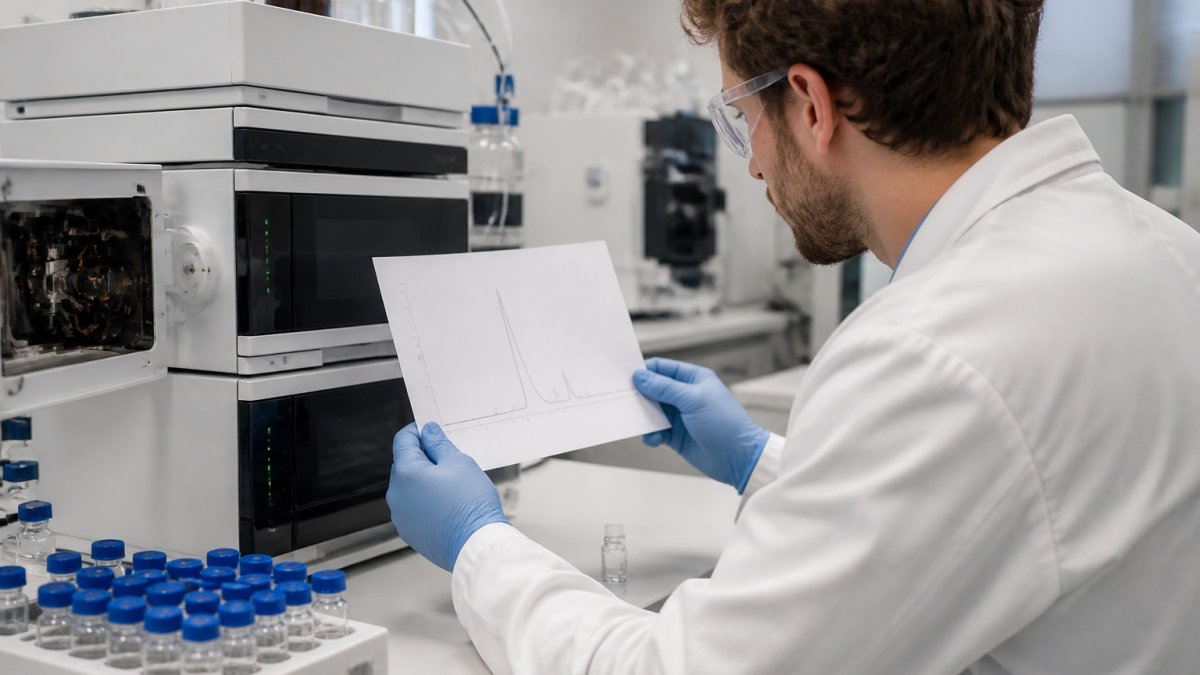
HPLC peptide purity testing separates the components of a sample by how they interact with a stationary phase, then measures how much of the signal belongs to the target peak.
A single number hides the interesting part. Read the chromatogram itself:
- Main peak shape – a broad or split peak suggests poor synthesis or partial degradation.
- Shoulder peaks – small humps beside the main peak often indicate closely related impurities.
- Early eluting peaks – frequently salts, solvents, or truncation fragments.
A lot reported at high purity with a messy baseline deserves a second look. Our step-by-step guide to verifying peptide purity covers how to interpret a chromatogram in practice.
What HPLC Can and Cannot Establish
The most common mistake in reading a purity report is treating a high percentage as a complete quality statement. It is not. RP-HPLC separates by hydrophobicity, so it is excellent at detecting closely related impurities and degradation fragments that differ in polarity.
| Question | HPLC (RP-HPLC, UV detection) | Mass spectrometry (ESI or MALDI-TOF) |
|---|---|---|
| Is the main peak the intended molecule? | Indirect, assumes the target elutes where expected | Direct, compares observed mass to theoretical mass |
| How much impurity is present? | Yes, as area percent of the chromatogram | No, MS is not a quantitative purity assay by itself |
| Are there co-eluting impurities? | Often missed if they share retention time | Detected if they differ in mass |
| Is the sequence correct? | No | No, mass confirms composition, not arrangement |
| Is there residual solvent or counterion? | Usually invisible | Usually invisible |
| Is the sample sterile or endotoxin-free? | No | No |
That table is the reason orthogonal testing exists. HPLC answers “how clean is this peak?” and MS answers “is this peak the right molecule?” Neither answers “is this lot safe for my intended use?”, that requires separate testing for sterility, endotoxin, and residual solvents, which are outside the scope of a standard purity-and-identity panel.
When Orthogonal Testing Is Worth It
A common pattern is to run HPLC alone on routine release and add MS when any of the following is true:
- The main peak shape changed between lots.
- The reported purity dropped without an obvious synthesis explanation.
- The lot is going into a long-duration study where a misidentified molecule would invalidate months of work.
Orthogonal testing is not free, and it is not necessary for every vial. But a purity report without an identity result is a partial answer, and a batch comparison built on partial answers is only as strong as its weakest lot. For a fuller treatment of reading these reports, see our guide to peptide mass spectrometry reports.
Mass Spectrometry Peptide Identity: Confirming the Molecule Is What the Label Says
Mass spectrometry peptide identity confirmation compares the measured molecular mass of your sample against the theoretical mass calculated from the stated sequence.
Two techniques are commonly used: electrospray ionization, which suits peptides in solution, and MALDI-TOF.
Watch out: a matching mass confirms the composition, not the arrangement. Isobaric impurities and certain sequence scrambles can share the same mass. Pair the MS result with chromatographic purity before you conclude the lot is clean.
Peptide Batch Traceability From Synthesis to Bench
Traceability is the documented chain linking a finished vial back to its synthesis run, purification fractions, and release test results. Without it, batch consistency testing has no anchor.
Every step in that chain should produce a record:
- Synthesis batch number assigned at the start of production.
- Purification record showing which fractions were pooled.
- Release testing results tied to that pooled material.
- Vial labeling that carries the same batch number forward.
- Storage and shipping records covering temperature exposure.
The weak link is almost always the handoff between purification and filling. If the batch number changes there without a documented mapping, the certificate and the vial can drift apart. Batch numbers should be verifiable, not decorative.
A Repeatable Workflow for Comparing Two or More Lots
Comparing lots is where most labs improvise, and improvisation is exactly how a reproducibility problem slips through.
Step 3: Reconstitute identically. Same diluent, same concentration target, same handling time. Record everything.
Step 4: Run the same assay. Use one method, one instrument, one operator where possible.
Step 5: Compare against criteria, not impressions. Score each attribute and record pass or fail.
Step 6: Document the decision. State which lot you accepted and why.
For a detailed walkthrough of this sequence, our article on how to compare peptide batches expands each step.
Setting Quantitative Acceptance Criteria
Vague standards produce vague comparisons. Define numeric limits before you test, and apply them to every lot the same way. The table below uses illustrative tolerances, not validated product specifications, your limits should come from your own method validation and intended use.
| Attribute | Illustrative Criterion | Why It Matters |
|---|---|---|
| Identity | Observed mass within the instrument’s stated tolerance of theoretical | Confirms the molecule |
| Purity | Meets your stated HPLC minimum, with no new shoulder peak above your reporting threshold | Limits impurities |
| Net peptide content | Within a set band of the labeled mass, commonly a few percent, set from your own assay variability | Controls effective dose |
| Appearance | Clear solution, no precipitate | Flags handling problems |
| Batch number | Matches COA exactly | Preserves traceability |
Set the band tight enough to catch drift and wide enough to survive normal analytical variation. Measurement uncertainty belongs in the criteria, not in an after-the-fact excuse.
Sampling, Replicates, and Measurement Uncertainty
A batch-level conclusion is only as good as the sample it rests on. Three practical rules keep the comparison honest:
- Sample representatively. A single vial pulled from the top of a lyophilized lot may not represent the lot. Where the question matters, sample across the lot and record which vials you pulled.
- Run replicates. A single injection cannot separate a real lot-to-lot difference from normal assay variability. Duplicate or triplicate injections of the same preparation give you a sense of the spread.
- Report uncertainty with the result. If your HPLC method varies by roughly a percentage point between runs, a one-point purity difference between lots is not a finding, it is noise. State the variability so the comparison can be interpreted correctly.
A common pattern is to compare two lots, see a small purity difference, and conclude the second lot is worse. Without replicate data and a stated uncertainty, that conclusion is unsupported.
A Decision Worksheet for Multi-Lot Comparisons
Use the same worksheet for every comparison so the record is auditable:
- Lot identifiers: batch numbers from each vial and each COA, matched character for character.
- Test dates: release date for each lot, plus the date you ran your own comparison.
- Method: instrument, column, wavelength, and injection volume for each run.
That worksheet is what turns a batch comparison from a judgment call into a documented decision.
Batch consistency is a measurement claim, not a label claim. Define your criteria before testing, account for analytical variability, and document the decision, otherwise you are comparing impressions, not lots.
Requesting Batch-Specific Verification Reports From Emerald Science
Documentation you cannot obtain is documentation you cannot rely on. We built our process around that gap.
Every Emerald Science lot is independently tested and mass-spec verified, with HPLC purity of at least 99%, and every product carries a unique batch number so the certificate you receive maps to the vial in your freezer.
If your grant or protocol requires you to see the analytical data before committing, contact Emerald Science to request the batch-specific reports for the lot you are considering.
Frequently Asked Questions
How do you compare peptide batches?
Line up the batch-specific COAs side by side and compare four defined quality attributes: identity (mass spec), purity (HPLC), net peptide content, and impurity profile. Confirm the lot numbers on the vials match the certificates, then check that each result falls inside your pre-set acceptance criteria. If any attribute drifts between lots, request the raw chromatogram and mass spectrum rather than the summary page, and run an in-house identity check on a sample before committing the batch to a long study.
What tests are used to check peptide batch consistency?
The core panel is HPLC for purity and impurity detection, mass spectrometry for molecular identity, and amino acid analysis or nitrogen determination for net peptide content. Karl Fischer titration covers residual water, and stability assays track degradation over time. For consistency specifically, you compare results across lots using the same method and the same acceptance criteria. Requesting that the supplier state the test method and instrument on the COA matters, because two labs running different gradients can report different purity figures for the same material.
Does a certificate of analysis prove that two peptide batches are equivalent?
No. A COA documents what was measured on one production lot, using one method, at one point in time. It does not prove equivalence to another lot unless both certificates report the same tests against the same acceptance criteria and the underlying data are comparable. Treat the COA as a claim to verify, not a guarantee. Independent testing of a sample from each lot, using your own lab’s methods, is the only way to confirm that peptide batch consistency holds in practice for your assay.
How can HPLC and mass spectrometry help evaluate a peptide batch?
HPLC separates the peptide from impurities and degradation products, giving you a purity percentage and a visual impurity profile. Mass spectrometry confirms the molecular weight matches the expected sequence, catching mis-synthesis or sequence errors that purity testing alone would miss. Used together, they answer two different questions: is the material clean, and is it the right molecule. A batch that passes HPLC but fails mass spec is the wrong peptide at high purity, which is worse for reproducibility than a slightly impure correct sequence.
What batch information should researchers record?
Record the lot number and batch number from the vial label, the supplier, the receipt date, the COA values for identity, purity, and net peptide content, and the storage conditions from arrival onward. Note the reconstitution date, solvent, and concentration if the peptide is put into solution, plus any freeze-thaw cycles. This record is what makes peptide batch traceability possible when a result looks off six months later. A PDF filed against the project number is enough; no specialized software is required.
How often should peptide batches be independently tested?
Test every new lot before it enters a study that depends on reproducibility, and retest after any long storage interval or freeze-thaw cycle if the peptide is critical to the assay. For routine work, a reasonable pattern is full identity and purity verification on receipt, then a purity check at the midpoint of a long study. If a lot fails in-house verification, test the remaining vials from that lot before discarding the material, so you can tell a single bad vial from a bad batch.
Consistency is not something you hope for between lots. It is something you specify, measure, and document, lot after lot. If your work depends on peptides that behave the same way every time, get started with Emerald Science and request the verification reports for your next batch.