
Last Updated: November 12, 2026
Quick Summary
Peptide purity testing standards define the analytical criteria a laboratory uses to confirm that a peptide sample contains the intended molecule, in the expected amount, without unacceptable levels of impurities. A complete purity claim rests on three separate measurements: HPLC purity, mass spectrometry identity confirmation, and an impurity profile. A purity percentage without the method behind it tells a researcher almost nothing.
- Reversed-phase HPLC is the workhorse method for peptides because most sequences retain predictably on a hydrophobic column.
- Mass spectrometry confirms molecular mass but cannot sequence a peptide from scratch.
- A complete certificate of analysis should include HPLC purity, mass spec results, water content, counterion, and storage recommendations.
- Specificity is the critical parameter when validating a peptide purity method against deletion sequences and oxidation products.
- Freeze-thaw cycles degrade peptides, so aliquot before freezing rather than repeatedly thawing a single stock.
Table of Contents
- What Peptide Purity Testing Standards Actually Measure
- HPLC Peptide Purity Analysis: What the Chromatogram Tells You
- Mass Spectrometry Peptide Identity Testing: Confirming the Molecular Mass
- Impurity Profiles and Contaminant Testing
- What a Peptide Certificate of Analysis Should Include
- Peptide Reference Standards for Testing and Method Validation
- Regulatory and Compendial Standards for Peptide Testing
- Sampling, Storage, and Stability: Keeping Test Results Valid
- Interpreting Purity Percentages and Method Limitations
- Verify Your Next Lot with Emerald Science
- Frequently Asked Questions
What Peptide Purity Testing Standards Actually Measure
Peptide purity testing standards define the analytical criteria a laboratory uses to confirm that a peptide sample contains the intended molecule, in the expected amount, without unacceptable levels of impurities. A purity figure without a method behind it tells a researcher almost nothing.
Three separate questions sit underneath any purity claim: how much of the sample is the target peptide, whether that peptide is chemically what the label says, and what else is in the vial. A certificate that answers only the first question leaves the other two open.
Purity, Identity, and Impurity Profiles
Purity is the proportion of the sample made up of the target peptide, usually reported as a percentage of total chromatographic peak area.
Identity confirms the amino-acid sequence and molecular mass match the intended structure.
Impurity profile lists what remains: deletion sequences, truncated fragments, oxidation and hydrolysis products, residual solvents, counterions, and water content. Each is a distinct measurement, and each requires its own method.
Why a Single Purity Percentage Is Not Enough
A sample can read 98% pure by area and still fail identity confirmation, or carry an impurity the chromatogram never resolved. Area percentage is relative, not absolute. It says nothing about how the detector responded to each component, whether co-eluting species were merged into one peak, or whether the method was validated for that particular sequence.
That is the gap most certificates leave open.
HPLC Peptide Purity Analysis: What the Chromatogram Tells You
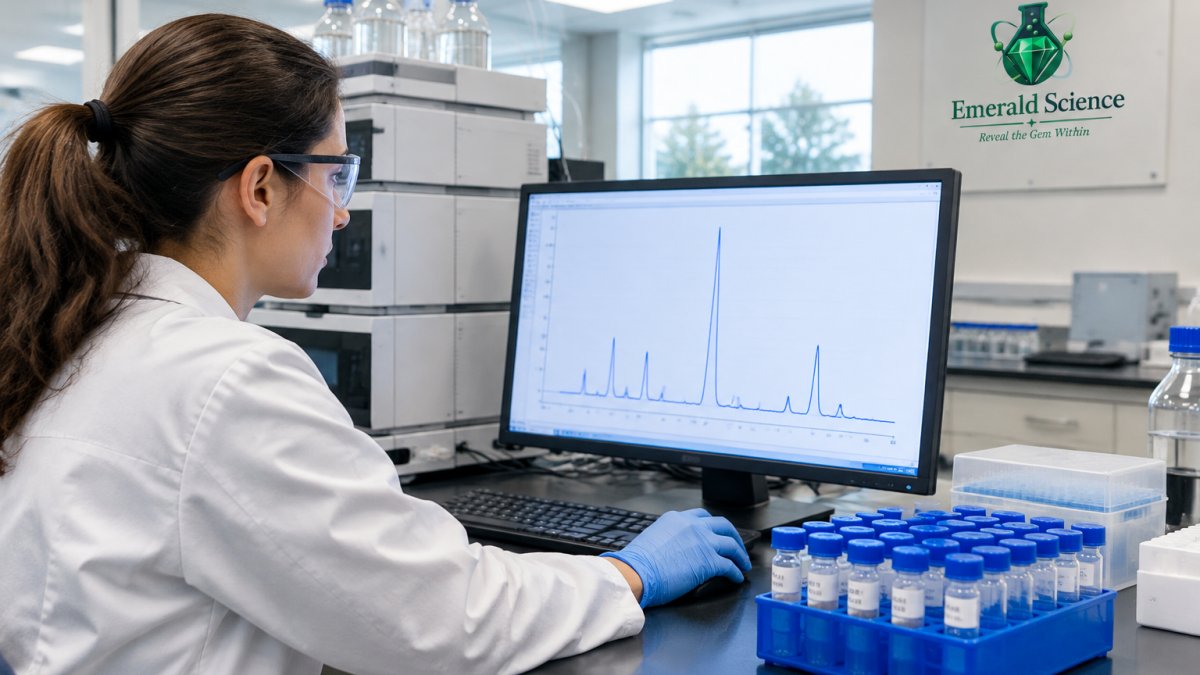
High-performance liquid chromatography separates the components of a sample by how they partition between a mobile phase and a stationary phase. Reversed-phase HPLC is the workhorse method for peptides because most sequences are water-soluble and retain predictably on a hydrophobic column.
The chromatogram is a plot of detector signal against time. Each peak represents a component eluting from the column, and the area under each peak is proportional to how much of that component passed the detector.
Reading Retention Time and Peak Area
Retention time identifies a peak by when it elutes. Compare the main peak against a reference standard run under identical conditions; a match supports identity but does not prove it alone.
Peak area gives the percentage. The main peak’s area divided by total peak area, multiplied by 100, is the purity figure most certificates report. For a deeper walkthrough of how these calculations are performed and reported, see our guide on what HPLC peptide purity means.
Watch out: a purity percentage calculated from a poorly resolved chromatogram is meaningless. If the main peak shows shoulders or the baseline drifts, the method needs adjustment before any number is trusted.
Mass Spectrometry Peptide Identity Testing: Confirming the Molecular Mass
Mass spectrometry peptide identity testing measures the mass-to-charge ratio of ionized peptide molecules and compares the result against the theoretical mass calculated from the intended amino-acid sequence. A match within the method’s tolerance confirms the molecule is the right size and composition.
Two ionization approaches dominate. Electrospray ionization produces multiply charged ions and suits peptides of moderate length. Matrix-assisted laser desorption/ionization produces predominantly singly charged ions and handles larger or more heterogeneous samples.
Neither technique sequences a peptide from scratch. Mass spectrometry confirms mass, and mass plus known composition supports identity. Full sequence confirmation may require tandem mass spectrometry or Edman degradation. Our mass spectrometry report guide explains how to read the spectra and what each peak represents.
Impurity Profiles and Contaminant Testing
Impurity testing asks what else is present and at what level. Deletion sequences, where one amino acid is missing from the chain, are the most common synthesis-related impurity. Oxidation products appear when susceptible residues such as methionine or tryptophan degrade. Residual solvents and counterions carry over from synthesis and purification.
Contaminant testing goes further and looks for what should never be there: endotoxin, microbial contamination, and heavy metals. Not every research application requires the full panel. In-vitro work generally demands less than an injectable-grade specification, but the panel should be stated explicitly rather than assumed.
A common mistake is treating a clean HPLC trace as proof of a clean sample. Chromatography sees what absorbs at the detection wavelength. Endotoxin and microbial contamination are invisible to it.
What a Peptide Certificate of Analysis Should Include
A peptide certificate of analysis is a lot-specific document that records the tests performed on a batch, the methods used, the results obtained, and the acceptance criteria applied. It should be traceable to a specific lot number.
A complete certificate typically carries:
- Peptide name, sequence, and lot number
- HPLC purity result with method conditions
- Mass spectrometry result with theoretical versus observed mass
- Appearance and solubility observations
- Water content and counterion identity
- Impurity panel results where applicable
- Storage recommendations and retest date
If any of those are missing, ask why. Our guide to reading a peptide COA walks through each field line by line.
Matching the COA to the Lot Number
The lot number is the thread that ties a vial to its documentation. Verify that the number printed on the vial matches the certificate exactly, then confirm the certificate is not a generic template shared across batches. A certificate without a lot number is a brochure, not a record.
For laboratories that need a structured verification process, our lot-matched certificate checks page covers what to confirm before accepting a shipment. No special software is required; a PDF filed alongside your research records is sufficient for most laboratory management systems.
A complete certificate should carry the following fields.
| Item | What it records |
|---|---|
| Peptide name, sequence, lot number | Identifies the material and batch |
| HPLC purity result | Includes method conditions |
| Mass spectrometry result | Theoretical versus observed mass |
| Appearance and solubility | Observations recorded |
| Water content and counterion | Identity stated |
| Impurity panel | Results where applicable |
| Storage and retest date | Recommendations stated |
Peptide Reference Standards for Testing and Method Validation
A peptide reference standard is a well-characterized material of known identity, purity, and potency used to calibrate instruments, verify method performance, and bracket unknown samples. Without a trusted anchor, every downstream measurement is relative and unverifiable. Most guides stop at that definition; the practical questions are how a standard is qualified, how it stays traceable, and what happens when it drifts.
Qualification and Traceability
Qualification begins with orthogonal characterization: amino-acid analysis to confirm composition, mass spectrometry for molecular mass, and HPLC for purity and impurity profile. A standard is only as good as the data package behind it. Traceability means the standard can be linked to a documented preparation or, where available, to a compendial reference material. When no compendial standard exists for a given peptide, laboratories often qualify an in-house standard by consensus testing across multiple methods and, where feasible, multiple operators.
Watch out: a certificate that lists a purity percentage but no characterization methods or traceability statement is not a reference standard, it is an unverified sample.
Using Standards in Method Validation
Method validation demonstrates that an analytical procedure reliably measures what it claims to measure. Key parameters include accuracy, precision, specificity, linearity, range, limit of detection, limit of quantitation, and robustness. For peptide purity methods, specificity is the critical parameter: the method must resolve the target peptide from deletion sequences, oxidation products, and other closely related impurities. A method validated for one sequence does not automatically transfer to another because retention behavior and impurity profiles differ.
A common pattern is to validate the HPLC method using the reference standard spiked with known impurities, then confirm that the main peak meets system suitability criteria (resolution, tailing factor, theoretical plates) before each analytical run. System suitability is not a formality, it is the check that the method is performing on the day of analysis.
Stability of the Standard Itself
Reference standards have their own shelf life. Store them under the conditions stated on their certificate, and requalify or replace them on a defined schedule. A standard that has degraded silently will bias every result calibrated against it. For lyophilized peptide standards, typical storage is desiccated at -20 °C or colder, protected from light, and equilibrated to room temperature before opening to prevent condensation. Once reconstituted, a standard solution should be aliquoted and frozen, not repeatedly thawed.
Regulatory and Compendial Standards for Peptide Testing
Regulatory expectations for peptide testing depend entirely on the intended use of the material. Peptides intended for human use fall under pharmaceutical requirements enforced by the U.S. Food and Drug Administration, including current good manufacturing practice and the analytical documentation that accompanies a drug application.
Research-use-only peptides occupy a different position. They are intended for laboratory and in-vitro work and are not approved for human use. That distinction governs which standards apply, and a supplier should state clearly which category a product belongs to.
Compendial monographs, where they exist for a given peptide, specify the tests and acceptance criteria that apply. Where no monograph exists, the specification is set by the manufacturer and should be documented. Researchers aligning their own quality systems can find practical guidance on meeting peptide quality control standards.
Sampling, Storage, and Stability: Keeping Test Results Valid
A test result is only as meaningful as the sample it was drawn from. Sampling, shipping, and storage conditions determine whether a reported purity figure represents the lot as it exists now or a material that has already changed. This is the step most purity guides skip, and it is where many discrepancies between a certificate and a retest originate.
Sampling and Chain of Custody
Sampling should be representative and documented. For lyophilized peptides, that means drawing from a homogenized lot rather than a single vial, recording the lot number, date, and conditions at sampling, and maintaining a chain of custody through testing. A sample pulled from a compromised vial, one with a broken seal, visible moisture, or atypical appearance, will not reflect the lot. If the sample is shipped to an external laboratory, include temperature monitors and specify the acceptable excursion range.
Stability-Indicating Methods
A stability-indicating method is one that can detect degradation products as they form, not just the parent peptide. Forced degradation studies, exposure to heat, light, humidity, oxidation, and acidic or basic conditions, demonstrate whether the method resolves degradants from the main peak. Without that evidence, a purity result cannot distinguish a stable lot from one that is degrading in a way the method cannot see.
Watch out: an HPLC method that has never been challenged with stressed samples may co-elute a degradation product with the parent peak, inflating the reported purity.
Storage and Handling Effects
Most lyophilized peptides tolerate ambient shipping for short periods but should be stored cold and dry for the long term. Once reconstituted, stability depends on the sequence, buffer, concentration, and storage temperature, and it should be established rather than assumed. Freeze-thaw cycles degrade peptides; aliquot before freezing rather than repeatedly thawing a single stock. The stability data on a certificate applies to the material as supplied, not to a solution stored on a bench for a month. When evaluating a certificate, check whether the reported results were generated on the lot as shipped or after accelerated stability testing, the two answer different questions.
Interpreting Purity Percentages and Method Limitations
Every purity percentage is conditional on the method that produced it. HPLC area percentage, the most commonly quoted figure, is relative and detector-dependent. It cannot see components that do not absorb, and it cannot separate species that co-elute.
Mass spectrometry confirms mass but not purity. A sample can be the correct molecule and still be heavily contaminated with closely related fragments that share the same mass. Combining methods covers each technique’s blind spot.
Treat any single number as one data point among several. A certificate showing HPLC purity, mass confirmation, and an impurity panel gives a researcher a defensible picture. A certificate showing a percentage and nothing else does not.
Verify Your Next Lot with Emerald Science
The hardest part of sourcing research peptides is trusting the documentation that arrives with the vial. Every Emerald Science lot is independently tested and mass-spec verified to at least 99% HPLC purity, and every product carries a unique batch number.
Confirming identity and purity before an experiment starts is far cheaper than repeating it afterward. Get started with Emerald Science and source peptides with documentation you can verify yourself.
Frequently Asked Questions
What is the acceptable purity for peptides?
There is no single acceptable purity for all peptides. The right threshold depends on the application: in-vitro assays and sensitive biological work typically call for 95% or higher by HPLC, while some screening work tolerates less. What matters most is that the certificate of analysis states the method used, the acceptance criteria, and the measured result for that specific lot. A stated purity without a method is not a standard you can verify.
Is 97% purity good for peptides?
For many research applications, 97% by HPLC is workable, but it is not automatically sufficient. The remaining 3% may include deletion sequences, truncated fragments, or counterions that interfere with sensitive assays. Check whether the 97% figure comes from HPLC area percent, what the impurity profile looks like, and whether mass spectrometry confirmed identity. For assays where trace impurities skew results, higher purity and full analytical documentation are safer.
Can mass spectrometry determine peptide purity?
Mass spectrometry confirms molecular mass and therefore identity, but it does not measure purity the way HPLC does. A mass spec result tells you the dominant species matches the expected sequence; it does not quantify how much of the sample is that species. Purity testing standards pair HPLC for quantitative purity with mass spectrometry for identity confirmation, so the two methods answer different questions and are used together.
What should a peptide certificate of analysis include?
A useful peptide certificate of analysis should list the peptide name and sequence, lot number, test methods (such as HPLC and mass spectrometry), the measured purity and molecular mass, acceptance criteria, and the date of testing. It should also address water content, counterion, and any residual solvents or contaminants tested. The lot number on the COA must match the lot number on the vial so the document can be traced to the exact batch.
How do you verify that a peptide test result matches its batch?
Match the lot number printed on the vial to the lot number on the certificate of analysis. Request the original analytical data, such as the chromatogram and mass spectrum, not just a summary line. If your lab has the capability, run an independent HPLC check on a sample from the same lot and compare retention time and peak profile. Consistent lot numbering and retained records are what make this traceability possible.
What are peptide reference standards for testing used for?
Peptide reference standards are well-characterized materials used to calibrate instruments, validate analytical methods, and confirm that a test system is performing correctly. They help a lab demonstrate that its HPLC method separates the target peptide from impurities and that mass spectrometry readings are accurate. Using a reference standard alongside unknown samples is a core part of method validation and ongoing quality control.