
Last Updated: November 5, 2026
Quick Summary
Peptide quality control standards are the analytical tests, acceptance criteria, and documentation confirming a peptide’s identity, purity, and quantity match its label. You need both purity testing and identity confirmation, since reversed-phase HPLC reports purity while mass spectrometry confirms molecular weight. A lot-specific peptide certificate of analysis ties these results to the vial in your hand.
- Reversed-phase HPLC reports purity as the main peak’s area percentage but misses non-absorbing or co-eluting impurities.
- LC-MS confirms molecular weight, and tandem MS can sequence fragments to catch substitutions.
- Amino acid analysis measures building-block ratios and catches compositional errors mass alone can miss.
- Match the lot number on the vial to the certificate character for character before trusting it.
- Independent testing carries more weight than in-house data on a peptide certificate of analysis.
Table of Contents
- Why Peptide Quality Control Standards Matter for Research
- Peptide Purity Testing and Identity Confirmation Methods
- Peptide Batch Number Verification and the Peptide Certificate of Analysis
- Frequently Asked Questions
Why Peptide Quality Control Standards Matter for Research
Peptide quality control standards are the analytical tests, acceptance criteria, and documentation confirming a peptide’s identity, purity, and quantity match its label. Storage is part of quality control: a lot can pass every release test and still degrade if it sat on a warm dock or was reconstituted and left on a benchtop. See our guide to peptide batch consistency testing.
Peptide Purity Testing and Identity Confirmation Methods
Purity testing answers how much of the material is the target peptide; identity confirmation answers whether it’s the right molecule. You need both. Reversed-phase HPLC reports purity as the main peak’s area percentage, though it only reflects what absorbs at the detection wavelength. Mass spectrometry, usually LC-MS, confirms molecular weight; tandem MS can sequence fragments and catch substitutions. Amino acid analysis measures building-block ratios, slower, but it catches compositional errors mass alone can miss. Orthogonal testing closes the gaps. For a step-by-step walkthrough, see a peptide purity verification guide.
| Test | What It Answers | Main Limitation |
|---|---|---|
| Reversed-phase HPLC | Purity percentage | Misses non-absorbing or co-eluting impurities |
| LC-MS | Molecular identity | Cannot always resolve isomers or substitutions |
| Amino acid analysis | Composition ratios | Slow, consumes sample |
Peptide Batch Number Verification and the Peptide Certificate of Analysis
A peptide certificate of analysis is the lot-specific document reporting tests run, methods, results, and acceptance criteria. Batch number verification confirms that document belongs to the vial in your hand.
- Match the lot number on the vial to the certificate, character for character.
- Confirm the test date falls near the release date.
- Check that methods are named, not just results.
- Look for identity data, not purity alone.
- Verify acceptance criteria are stated.
- Confirm the document is lot-specific, not a generic template.
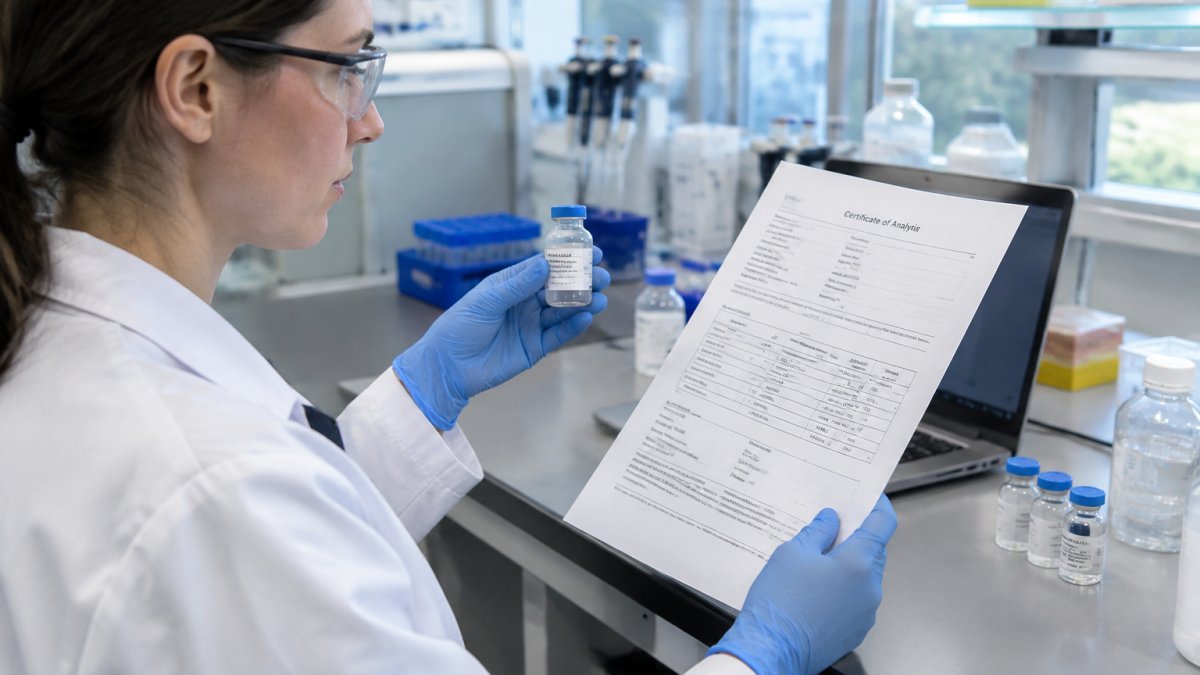
Filing these as PDFs is fine, just tie the filename to the lot and study. For details, read how to read a peptide COA, our lot-matched certificate checks, and batch number verification steps. A certificate is only as good as the lab behind it, independent testing carries more weight than in-house data.
Frequently Asked Questions
What quality control tests are used for peptides?
Most research-grade peptide quality control combines HPLC purity testing with mass spectrometry for identity confirmation. HPLC separates the peptide from impurities and reports a purity percentage, while mass spectrometry verifies the molecular weight matches the intended sequence. A certificate of analysis should list both results per lot, along with the batch number, storage guidance, and any detected impurities or degradation products.
How is peptide purity measured?
Purity is typically measured by reversed-phase HPLC, which separates components in a sample and reports the main peak as a percentage of total peak area. A result of 99% or higher indicates most of the material is the target peptide. Because the number depends on the method, column, and detection wavelength, compare results only when the analytical method is stated, and treat purity and identity as separate checks.
Does bacteriostatic water affect peptide storage?
Bacteriostatic water contains benzyl alcohol, which slows bacterial growth in reconstituted solutions but can also affect peptide stability depending on the sequence. For long-term storage, keep lyophilized peptides dry and frozen, and reconstitute only the amount you will use. Follow the storage instructions on the certificate of analysis, and note that reconstitution starts the clock on degradation regardless of the diluent used.
Research peptides are not commodities, and treating them like one is how experiments fail. Emerald Science tests every lot independently, confirms identity by mass spec, and prints a unique batch number on every product so the certificate you file actually matches the vial on your shelf. Orders placed before 2 PM EST ship the same day. Get started with Emerald Science and put verified material behind every experiment.