
Table of Contents
- Understanding Research Peptide Shipping and Delivery Options
- Research Peptide Shipping Time: What to Expect
- Research Peptide Tracking and Chain of Custody
- Peptide Shipping and Storage Requirements
- Peptide Certificate of Analysis: Verification Upon Arrival
- Evaluating Supplier Shipping Policies and Reliability
- Addressing Common Shipping Challenges
- Frequently Asked Questions
Last Updated: October 16, 2026
Understanding Research Peptide Shipping and Delivery Options
Shipping and delivery protects your experiment’s integrity from the moment a batch leaves the supplier until it reaches your lab.
Research peptide shipping and delivery directly affects your results: a peptide that arrives damaged, improperly stored, or undocumented can compromise months of work.
Below, we cover research peptide shipping and delivery options, from transit times to storage to verification on arrival.
Research Peptide Shipping Time: What to Expect
Most suppliers offer multiple shipping options; the timeline depends on urgency and location.
Same-day shipping is available from select suppliers, and Emerald Science offers same-day fulfillment for orders placed before 2 PM EST.
The real question isn’t speed but whether the supplier can guarantee your peptides remain stable in transit.
What affects shipping speed:
- Distance from the supplier’s facility to your lab
- Your selected shipping tier (standard vs. overnight)
- Weekends and holidays (which pause delivery)
For time-sensitive research, overnight shipping makes sense; for routine orders, standard shipping suffices if the supplier uses proper packaging and temperature control.
Research Peptide Tracking and Chain of Custody
A reliable supplier provides a tracking number within hours of shipment, but tracking location is only part of the picture.
Chain of custody matters more: the documented record of who handled your peptide, when, and under what conditions. A complete record includes:
- Batch number and lot identification
- Supplier’s shipping date and time
- Carrier name and tracking number
Without proper chain-of-custody documentation, you cannot defend your results later, grant agencies, peer reviewers, and your institution may require proof your materials were handled correctly.
Red flags in shipping practices:
- Supplier cannot provide tracking until days after shipment
- No batch number printed on the package
- Shipping containers lack temperature indicators
Peptide Shipping and Storage Requirements
Temperature control is necessary but not sufficient: material can leave and arrive at the correct temperature yet still be compromised by an undocumented handling gap. Below are the physical requirements, the documentation that makes them verifiable, and decision rules for when something goes wrong.
Temperature requirements by compound class
Most research peptides fall into one of three shipping categories, which the supplier should state on the product page and shipping label:
- Refrigerated (2-8°C): Common for lyophilized (freeze-dried) peptides in short transit. Lyophilized powder is generally the most tolerant form.
- Frozen (-20°C): Typical for reconstituted peptide solutions and for longer transit windows.
- Dry ice (-70°C or below): Used for certain labile sequences and for some reconstituted stocks where the supplier specifies ultra-cold handling.
Lyophilized powder tolerates brief ambient exposure better than reconstituted solution, which is why many suppliers ship powder for reconstitution on arrival. If a supplier ships reconstituted peptide at ambient temperature without justification, ask why.
Packaging components that actually matter
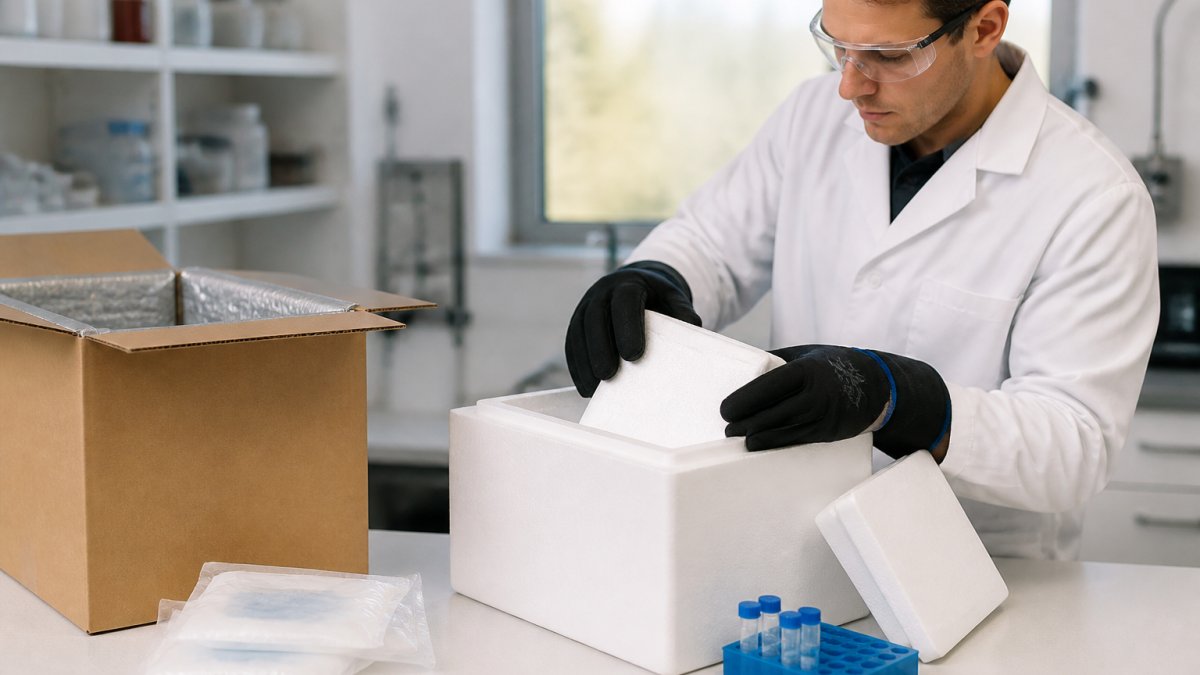
- Insulated shipper (molded foam or vacuum-insulated panel) sized to the payload, an oversized box with one ice pack is a common failure mode.
- Coolant matched to transit time: gel packs for short refrigerated runs, dry ice for frozen shipments, with quantity calculated for the carrier’s worst-case delay.
- Temperature indicator, a single-use threshold indicator (shows whether a limit was exceeded) or a time-temperature data logger (records the full profile). A logger is strictly more informative.
A temperature indicator tells you whether a threshold was crossed. It does not tell you for how long, at what point in transit, or whether the material was above the threshold when it mattered. If your work is sensitive to excursion duration, request a data logger.
Chain-of-custody documentation for shipments
Chain of custody is the written record of who held the material, when, and under what conditions. A defensible record typically includes:
- Supplier name, ship date, and ship time
- Lot number and quantity shipped
- Carrier name and tracking number
This record lets you answer later questions from a grant reviewer, institutional reviewer, or collaborator. Without it, you have a vial and a memory.
Receiving inspection: a decision rule, not a vibe check
On arrival, do the following in order and record what you find:
- Photograph the package before opening, exterior condition, label, any visible damage.
- Read the temperature indicator or download the logger before opening the inner container. Record the result.
- Compare the lot number on the vial to the lot number on the packing slip and the COA. If they do not match, stop.
- Inspect the material, lyophilized cake should be intact and uniform; solution should be clear unless the product is specified otherwise.
- Transfer to storage within the supplier’s stated window (commonly within a couple of hours for refrigerated or frozen material).
- Log the receipt in your chain-of-custody record.
Decision rules:
- Indicator shows a threshold was exceeded: do not use the material. Document the reading, photograph the indicator, and contact the supplier. A supplier with a credible quality system will replace the lot.
- Indicator intact but package visibly damaged or delayed beyond the coolant’s rated duration: treat as a suspected excursion and request replacement or documented justification for use.
- No indicator and no logger: you cannot verify the cold chain, for sensitive work, change suppliers rather than hope.
Storage after arrival
- Lyophilized powder: store at the supplier-specified temperature, typically -20°C long-term. Desiccate and protect from light.
- Reconstituted solution: store per supplier instructions, typically refrigerated short-term and frozen in aliquots for longer storage.
- Avoid frost-free freezers, the automatic defrost cycle produces temperature swings.
Handling after testing can undo what the testing confirmed. A lot that was analytically clean when it left the lab can be compromised by a broken cold chain, a contaminated reconstitution, or repeated freeze-thaw cycles. Analytical results describe the sample at the time of testing, not the material in your freezer six months later.
When something goes wrong
Temperature excursion: document the indicator or logger reading, photograph it, and contact the supplier before using the material.
Delayed delivery: if the delay exceeds the coolant’s rated duration, treat the shipment as a suspected excursion even if the indicator looks acceptable.
Incomplete documentation: if the COA, packing slip, or lot number is missing or inconsistent, resolve it in writing before the material enters your workflow.
International collaborators: import rules vary by destination and compound.
IATA dangerous goods guidance for dry ice shipments
CDC guidance on import permits for biological materials
Peptide Certificate of Analysis: Verification Upon Arrival
Your Certificate of Analysis (COA) ties a specific lot to a specific set of test results. Treating it as a checkbox, “does it say 98%?”, leaves you with documentation that looks fine but proves nothing about the vial in your hand.
What follows is a reproducible verification workflow for every incoming lot, plus what the underlying analytical methods can and cannot establish.
A step-by-step COA verification workflow
Run these steps in order; if any fails, stop and resolve it before using the material.
- Match the lot identifier, not just the product name. The lot number on the vial label, packing slip, and COA must be identical character-for-character; product-name matches are meaningless.
- Confirm the report is lot-specific. A COA with a product name and purity figure but no lot number is a catalog spec sheet, not a batch record. Ask for the lot-specific version in writing.
- Check the test date against the ship date. A report dated months before your order may describe a different lot; one dated after your order shipped is a red flag.
- Identify the testing laboratory by name. “Third-party tested” without a named, independently findable lab is a marketing phrase.
- Contact the named lab to confirm the report. Using contact information you found yourself, not the number on the COA, ask whether they issued a report for that lot on that date. Contract labs generally confirm or deny issuance without disclosing client-confidential data.
- Request the raw data behind the summary. Ask for the actual HPLC chromatogram and mass spectrum, not just summarized percentages; a one-line “purity: 98.4%” is a conclusion, the chromatogram is the evidence.
- Reconcile the methods listed with the claims made. If the COA claims identity confirmation but lists only HPLC, the claim is unsupported, identity requires a method measuring mass or structure, such as mass spectrometry.
- File the COA with the lot number, receipt date, and storage location. Chain-of-custody documentation starts the day the material arrives.
Build a one-page intake form for every lot: lot number, COA date, testing lab, methods used, raw data received (yes/no), lab confirmation (yes/no), storage location, and receiving date. Ten minutes of paperwork per lot saves weeks of reconstruction later.
What HPLC, mass spectrometry, and purity percentages actually prove
A purity percentage and an identity confirmation are different measurements, and conflating them is a common supplier-evaluation error.
HPLC (high-performance liquid chromatography) separates components by how they interact with a column and solvent, producing a chromatogram with peaks.
Mass spectrometry (MS) measures the mass-to-charge ratio of ionized molecules, establishing whether a molecule of the expected mass is present.
Methods that are commonly missing from research-grade COAs:
- Amino acid analysis or peptide mapping (sequence confirmation)
- Residual solvent testing (GC)
- Endotoxin testing (LAL)
A COA reporting only HPLC purity is not fraudulent, just incomplete for many research purposes.
A purity number is a measurement of a sample, not a warranty about a product. It says nothing about sterility, endotoxin, residual solvents, or suitability for any particular use. Research-use-only materials are not approved medicines, and no analytical result changes that.
Questions to ask about COAs
- Is the COA lot-specific, and does the lot number match my vial exactly?
- Who performed the testing, the supplier’s in-house lab or an independent lab?
- Can I have the name and contact information of the testing laboratory?
FDA guidance on analytical procedures and methods validation
USP general chapter on chromatographic methods
Evaluating Supplier Shipping Policies and Reliability
Before your first order, ask about shipping guarantees: do they promise temperature-controlled delivery, what happens if a peptide arrives damaged or out of range, and is there a replacement or refund policy?
Questions to ask a potential supplier:
- What shipping options do you offer, and what are the timeframes?
- Do you guarantee temperature control during transit?
- How do you document chain of custody?
Reliability also depends on consistency: a supplier that ships late or provides incomplete documentation creates friction, and managing multiple projects demands a supplier you can count on.
Look for transparent contact information and a track record of responsiveness; if you can’t reach a supplier by phone or email, that’s a warning sign.
Emerald Science maintains USA fulfillment with same-day shipping for orders placed before 2 PM EST. This reliability matters when your research timeline is tight.
Addressing Common Shipping Challenges
Temperature excursion: If the indicator shows your package exceeded safe limits, don’t use the peptide, request replacement.
Incomplete documentation: If the COA is missing, the batch number doesn’t match, or testing information is vague, ask for clarification before using the peptide.
Shipping to international collaborators: If sending peptides outside the United States, research the destination’s import regulations, some peptides require special permits or documentation.
Research peptide shipping and delivery options directly shape your experimental success.
Frequently Asked Questions
How long does research peptide shipping usually take?
Standard research peptide shipping typically ranges from 1-3 business days for domestic fulfillment, depending on your location and the supplier’s distribution network. Expedited options like same-day shipping are available from suppliers with regional fulfillment centers for orders placed before specified cutoff times (e.g., 2 PM EST). International shipping may require 5-14 business days plus customs clearance. Always confirm delivery windows with your supplier before placing time-sensitive orders.
What should I check when verifying a research peptide shipment arrives?
Upon arrival, verify the lot number and batch-specific documentation match your purchase order. Cross-reference the peptide certificate of analysis (COA) with your order to confirm purity percentage, identity testing results (HPLC and mass spectrometry), and expiration date. Inspect the packaging for signs of damage or temperature excursion (e.g., melted ice packs, condensation). Check that the physical product condition matches the COA description. Request a replacement immediately if discrepancies exist or if the shipment shows evidence of improper handling during transit.
How can I track my research peptide shipment?
Most research peptide suppliers provide real-time tracking via carrier integration, allowing you to monitor your shipment’s location and estimated delivery date. Request a tracking number immediately after your order ships. Verify that your supplier uses temperature-monitored carriers or insulated packaging with tracking sensors for temperature-sensitive peptides. Some suppliers offer batch-specific tracking tied to your lot number, which helps confirm chain of custody. If tracking is unavailable, request written confirmation of shipment date and carrier information from your supplier.
What are the regulatory requirements for shipping research peptides?
Research peptides designated for research use only are typically shipped under standard parcel regulations without hazmat classification in most cases. However, verify compliance with your institution’s receiving policies and any grant-specific requirements (e.g., NIH, NSF protocols). Suppliers must maintain proper documentation of shipment conditions, especially for peptides requiring cold chain maintenance. Check that your supplier’s shipping practices provide batch-specific documentation for audit trails. Always confirm with your institution’s procurement or compliance office before ordering.