
Table of Contents
- What Research Peptides Retatrutide Actually Are
- How Retatrutide Certificate of Analysis Documents Verify a Lot
- Retatrutide Mass Spectrometry Testing and HPLC Purity Explained
- Retatrutide Peptide Supplier Comparison: What to Check Before Ordering
- Retatrutide Research Peptide Storage and Handling in the Lab
- Research Chemical Status, Safety Evidence, and What Remains Unknown
- How Retatrutide Compares With Semaglutide and Tirzepatide
- Conclusion
- Frequently Asked Questions
Last Updated: October 19, 2026
What Research Peptides Retatrutide Actually Are
Research peptides retatrutide is a laboratory-grade, investigational molecule supplied for in-vitro study, not a medicine, and it carries the alternate designation LY3437943 in the scientific literature. At Emerald Science, we supply this compound strictly for laboratory and in-vitro work, and we insist researchers understand what it is before ordering. Retatrutide is a synthetic peptide built from 39 amino acids, designed to act on three receptor pathways at once.
LY3437943: One Molecule, Three Receptor Targets
The molecule’s alternate name, LY3437943, appears throughout the trial record and in reference databases. Retatrutide is a triple agonist, meaning it engages the GIP receptor, the GLP-1 receptor, and the glucagon receptor (GCGR) simultaneously. Those three receptor pathways are the reason researchers study it. GIP stands for glucose-dependent insulinotropic polypeptide, and GLP-1 for glucagon-like peptide-1. Both are incretin pathways tied to appetite and metabolic signaling.
What the Clinical Trial Record Shows
Clinical-trial participants in published studies of retatrutide have been evaluated for effects on body weight, food intake, and appetite. Researchers have also looked at gastric emptying and broader metabolic disease markers. The findings are promising enough to justify continued clinical research, and that is the honest summary. Scientific studies so far include animal studies and human trials of varying size.
How Retatrutide Certificate of Analysis Documents Verify a Lot
A retatrutide certificate of analysis is the single document that tells you whether the vial in your hand matches the label, and it should arrive with every lot, not on request. The certificate ties a specific batch number to its test results.
Here is what we would check, in order:
- Molecular identity confirmed by mass spectrometry, matching the expected mass for the 39-amino-acid sequence
- Purity percentage from HPLC, with the chromatogram attached rather than just a number
- Batch number that matches the vial label exactly
What most guides miss is the difference between a certificate and a marketing claim. A vendor that says “99% pure” in ad copy has told you nothing.
The most common mistake we see is researchers accepting a certificate that lists a batch number different from the vial in their freezer. That mismatch breaks traceability, and when your independent testing disagrees with the vendor’s numbers, you have no recourse.
Retatrutide Mass Spectrometry Testing and HPLC Purity Explained
Mass spectrometry testing confirms what the molecule is; HPLC confirms how much of it is there.
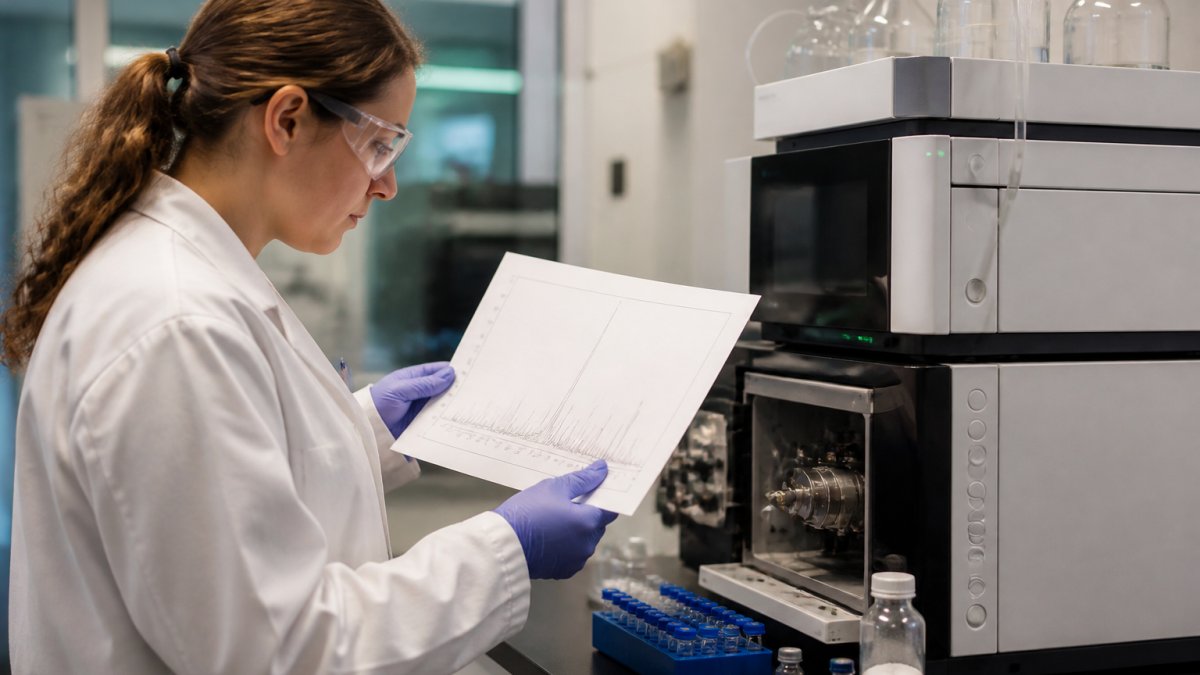
Mass spectrometry measures molecular mass. For a peptide, the observed mass must match the theoretical mass of the intended sequence, allowing for the trifluoroacetate salt form that peptides commonly carry.
Ask for the chromatogram, not just the purity number. A printed percentage with no trace behind it is unverifiable. The trace shows peak shape, retention time, and impurity profile, which is where problems hide.
Retatrutide Peptide Supplier Comparison: What to Check Before Ordering
A retatrutide peptide supplier comparison comes down to documentation, not price. Any provider can list a product. Fewer can hand you a lot-matched certificate, a mass-spec trace, and a batch number that survives scrutiny.
| Check | What Good Looks Like | Why It Matters |
|---|---|---|
| Certificate of analysis | Lot-matched, with chromatogram | Proves identity and purity for your batch |
| Mass-spec data | Attached, not on request | Confirms the peptide sequence |
| Batch numbering | Unique per lot, on vial and certificate | Enables traceability and repeat orders |
| Testing | Independent laboratory named | Reduces in-house bias |
| Fulfillment | Stated cut-off and shipping method | Protects compound stability in transit |
| Product status | Clearly labeled research use only | Confirms it is not sold as a medicine |
We built Emerald Science around that checklist. Every lot is independently tested and mass-spec verified to at least 99% HPLC purity, and every product carries a unique batch number.
Documentation, Batch Traceability, and Fulfillment
Batch traceability is what lets a postdoc lab order three or four times a year and still reproduce earlier results. When you reorder, the batch number tells you whether you are working with the same lot or a new one. Keep the certificate for every lot you use. Fulfillment speed matters too, since peptides are sensitive to transit time and temperature.
Retatrutide Research Peptide Storage and Handling in the Lab
Retatrutide research peptide storage follows the same principles as any lyophilized peptide: keep it cold, keep it dry, and keep it away from light. The exact stability profile depends on the specific lot and its salt form, so the certificate and the supplier’s handling notes are your primary reference.
Practical steps we recommend:
- Store lyophilized powder frozen, per the supplier’s stated temperature
- Let vials equilibrate to room temperature before opening to avoid condensation
- Reconstitute only with the specified solvent and volume
A common mistake is skipping the equilibration step. Cold vial, warm room, moisture enters, and the peptide degrades before your first assay.
Research Chemical Status, Safety Evidence, and What Remains Unknown
Retatrutide is an investigational molecule, and that status is a legal and scientific category, not a marketing label. Understanding what it means, and what it does not, is the difference between using the compound responsibly in a lab and misrepresenting it as something it is not.
What ‘Investigational’ Actually Means
In the United States, an investigational drug is one that has not received marketing approval from the Food and Drug Administration for any indication. Retatrutide falls in that category: it has been studied in clinical trials under an investigational new drug framework, but it is not an approved medicine, and no approved product exists. That has three practical consequences:
- No approved dosing. There is no FDA-approved label, no approved indication, and no approved dose for any human use. Dosing schedules seen in trial protocols were designed for controlled research and monitored participants; they are not prescribing guidance.
- Trial access is narrow. Human access to an investigational drug generally occurs through enrollment in an authorized clinical trial or, in limited circumstances, through expanded-access or compassionate-use pathways overseen by the FDA and the trial sponsor. Buying a vial from a research-chemical vendor is not one of those pathways.
- Research-use products are not trial materials. A compound sold ‘for laboratory research only’ is not the same article as the drug product administered in a clinical trial. It has not been manufactured under pharmaceutical good-manufacturing-practice controls, has not been sterility-tested for human injection, and is not accompanied by the batch release documentation a trial sponsor maintains.
What the Safety Evidence Shows, and What It Doesn’t
The safety record for retatrutide comes from clinical trials and animal studies, and it is incomplete by definition. Across the published trial program, the most commonly reported adverse events have been gastrointestinal, nausea, vomiting, diarrhea, and constipation, consistent with the incretin-based drug class. These events were generally described as mild to moderate and often transient, but they are real, they affect tolerability, and they are the reason dose titration exists in trial protocols.
What the record does not yet provide:
- Long-term safety data. Trials run for months, not decades. Effects on pancreatic, thyroid, renal, or cardiovascular outcomes over years of exposure are not established.
- Rare-event detection. Trials of a few hundred to a few thousand participants cannot reliably detect adverse events that occur at low frequency.
- Real-world use data. Trial participants are screened, monitored, and followed under protocol. Unsupervised use in broader populations is a different exposure profile entirely.
Do not infer human dosing, safety, or suitability from trial data. Trial participants were monitored under protocols with defined inclusion criteria, titration schedules, and follow-up. A research setting is not a clinic, and a research chemical is not a trial drug product.
How to Assess Claims and Product Documentation
Because retatrutide is sold only for laboratory research, the burden of verifying what is in the vial falls on the researcher. A neutral checklist helps separate documentation from marketing:
| Claim or document | What to verify |
|---|---|
| ‘99% pure’ in ad copy | Ask for the lot-matched certificate of analysis with the HPLC chromatogram attached |
| Certificate of analysis | Batch number on the certificate must match the vial label exactly |
| Identity testing | Mass spectrometry result matching the theoretical mass of the 39-amino-acid sequence, allowing for the salt form |
| Purity testing | HPLC method stated, main-peak percentage reported, chromatogram shown |
| Testing laboratory | Named independent lab, with a date of analysis |
| Research-use-only disclaimer | Present and unambiguous; a product marketed for human use is a red flag |
| Storage and handling notes | Consistent with a lyophilized peptide’s stability profile |
A certificate that lists a different batch number than the vial in your freezer breaks traceability. A purity percentage with no chromatogram behind it is unverifiable. A vendor that will not name its testing laboratory is asking you to trust a claim rather than a result. None of these checks endorses a vendor; they simply tell you whether the documentation supports the experiment you plan to run.
Treat every retatrutide result as provisional. The molecule is investigational, the long-term safety record is still being written, research-use products are not approved medicines, and your conclusions should reflect those limits explicitly.
How Retatrutide Compares With Semaglutide and Tirzepatide
The clearest way to understand retatrutide is against the two molecules it is most often compared with. Semaglutide is a GLP-1 receptor agonist. Tirzepatide is a dual agonist, acting on GIP and GLP-1.
| Feature | Semaglutide | Tirzepatide | Retatrutide |
|---|---|---|---|
| Receptor targets | GLP-1 | GIP + GLP-1 | GIP + GLP-1 + GCGR |
| Agonist class | Single | Dual | Triple |
| Approval status | Approved medicine | Approved medicine | Investigational |
| Research supply | Not applicable | Not applicable | Research use only |
| Primary research interest | Incretin signaling | Dual-pathway effects | Triple-pathway effects |
That third receptor is the whole story. It is also why retatrutide remains a research chemical while the other two are approved medicines. The comparison is useful for framing a study, not for implying equivalence.
Conclusion
The hard part of working with research peptides retatrutide is not finding a supplier. It is finding one whose documentation holds up when your lab independently tests the batch and the numbers disagree. That is the risk every principal investigator and lab manager carries, and it is the one we built our process around. Emerald Science provides HPLC purity of at least 99% on every lot, independent testing with mass-spec verified identity, and unique batch numbers matched to certificates you can file directly.
Frequently Asked Questions
How can researchers verify the purity of a retatrutide research peptide?
Ask for the lot-specific certificate of analysis and read it against the vial label. The COA should show an HPLC purity figure of at least 99%, a mass spectrometry result matching the expected molecular weight of the 39-amino-acid sequence, and a batch number that matches the product you received. Then run your own in-house check, such as analytical HPLC or mass spec, on arrival. Independent verification is the only way to confirm that a supplier’s stated purity holds for the specific lot in your freezer, since published specifications describe a process, not a guarantee for every vial.
What documentation should a retatrutide peptide supplier provide?
At minimum: a lot-specific certificate of analysis with HPLC chromatogram and mass spec data, the batch or lot number printed on both the COA and the vial, the peptide sequence and molecular weight, storage recommendations, and a stated research-use-only designation. A supplier that only offers a generic COA on request, or one that cannot tie the document to your specific lot, leaves you unable to trace experimental results back to a verified source. Emerald Science issues a unique batch number on every product so the paperwork and the vial stay linked.
Is it legal to buy research peptides, and can retatrutide sold online be used for human consumption?
Retatrutide is an investigational molecule that has not been approved by the FDA for any human use. Research peptides are sold for laboratory and in-vitro research only, and labeling them as research-use-only does not make them lawful for human consumption. Buying a research chemical is a different act from buying an approved medicine, and the two should never be treated as interchangeable. If you are considering retatrutide for a clinical or personal health purpose, that decision belongs with a licensed physician and an approved trial protocol, not a research catalog.
How should a retatrutide research peptide be stored once it arrives?
Store the lyophilized powder at -20°C or colder, protected from light, and let the sealed vial equilibrate to room temperature before opening to avoid condensation pulling moisture into the powder. Once reconstituted, keep the solution refrigerated and use it within the window your protocol specifies, avoiding repeated freeze-thaw cycles that degrade the peptide. Record the batch number, arrival date, and storage location in your lab notebook so a later purity question can be traced back to a specific lot and handling history.